囱 (cōng) means "Chimney" in Chinese. It has 7 strokes with the radical 囗, and is HSK Level 7.
Rated 3.5/5 in difficulty (challenging).
Harder than 16% of HSK Level 7 characters.
Appears in 3+ common words including 烟囱 (yān cōng), 囱口 (cōng kǒu), 烟囱帽 (yān cōng mào).
Due to its 7 strokes, Hanzi Writer's error detection shows 囱 requires focused practice — most learners need 10+ attempts for consistent accuracy.
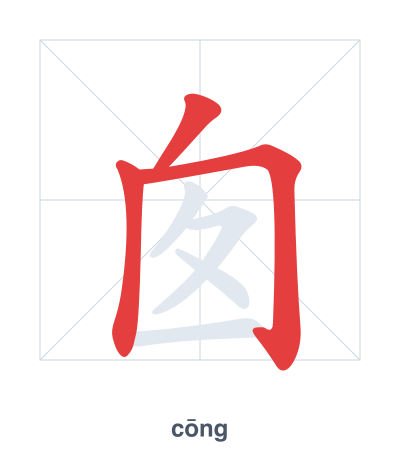
Open Hanzi Writer to see the animated stroke order and practice writing 囱 with real-time feedback.
The character 囱 (cōng) is written with 7 strokes. Follow the standard Chinese stroke order: top to bottom, left to right, outside before inside. The radical 囗 is one of its key components.
Practice the correct stroke order with the Hanzi Writer app to see animated stroke-by-stroke guidance with real-time feedback.
囱 means Chimney.
As an HSK Level 7 character, 囱 is an intermediate-level character.
This character originally depicted a window or opening in a roof, with ancient oracle bone forms showing a square enclosure (囗) with a lattice or vent-like pattern inside. Over time, it came to specifically mean 'chimney', the smoke vent that sticks out from a roof.
💡 Memory Tip: Picture a square house (囗) with a little chimney pipe (the top strokes like 八 or 夕) rising from its roof, puffing smoke.
房顶有一个烟囱。
fáng dǐng yǒu yí gè yān cōng
There is a chimney on the roof.
烟从囱口冒出来。
yān cóng cōng kǒu mào chū lái
Smoke is coming out of the chimney.
烟囱帽坏了。
yān cōng mào huài le
The chimney cap is broken.
Open Hanzi Writer to see the animated stroke order and practice writing 囱 with real-time feedback.
✨ Animated stroke order · Handwriting recognition · HSK-graded practice · Free to use
The character 囱 consists of an outer enclosure 囗 (representing a frame or opening) and an inner structure that resembles a passage or vent. Together, they depict a chimney—a hollow structure with an opening for smoke to escape.