憷 (chù) means "to be afraid" in Chinese. It has 16 strokes with the radical 忄.
Rated 4.2/5 in difficulty (advanced).
Appears in 3+ common words including 发憷 (fā chù), 憷场 (chù chǎng), 憷头 (chù tóu).
Due to its 16 strokes, Hanzi Writer's error detection shows 憷 requires focused practice — most learners need 10+ attempts for consistent accuracy.
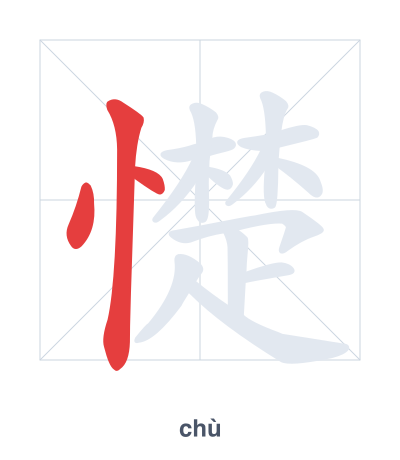
Open Hanzi Writer to see the animated stroke order and practice writing 憷 with real-time feedback.
The character 憷 (chù) is written with 16 strokes. Follow the standard Chinese stroke order: top to bottom, left to right, outside before inside. The radical 忄 is one of its key components.
Practice the correct stroke order with the Hanzi Writer app to see animated stroke-by-stroke guidance with real-time feedback.
憷 means to be afraid.
憷 is a compound character. The left radical 忄 (heart) indicates an emotion, while the right component 疌 (meaning quick or hurried) suggests the rapid heartbeat that comes from fear.
💡 Memory Tip: Picture a heart (忄) beating so fast it jumps into a quick step (疌) because it's terrified.
我一考试就发憷。
wǒ yī kǎo shì jiù fā chù
I get nervous whenever I take an exam.
他上台表演不憷场。
tā shàng tái biǎo yǎn bù chù chǎng
He doesn't get stage fright when performing.
学数学让他很憷头。
xué shù xué ràng tā hěn chù tóu
Studying math makes him feel daunted.
Open Hanzi Writer to see the animated stroke order and practice writing 憷 with real-time feedback.
✨ Animated stroke order · Handwriting recognition · HSK-graded practice · Free to use
The left radical 忄 (heart) indicates that the character relates to emotions or feelings. The right part 尗 (shú) may have originally provided a phonetic hint, though the pronunciation differs. Together they form a character meaning "to be afraid" — the heart radical shows it is an emotional state.