Hanzi Writer

How to Write 嘈 (cáo) — Meaning “Noisy.”

cáo 14 strokes Radical: 口

嘈 (cáo) means "Noisy." in Chinese. It has 14 strokes with the radical 口.

Rated 4.2/5 in difficulty (advanced).

Appears in 3+ common words including 嘈杂 (cáo zá), 吵嘈 (chǎo cáo), 嘈嚷 (cáo rǎng).

Due to its 14 strokes, Hanzi Writer's error detection shows 嘈 requires focused practice — most learners need 10+ attempts for consistent accuracy.
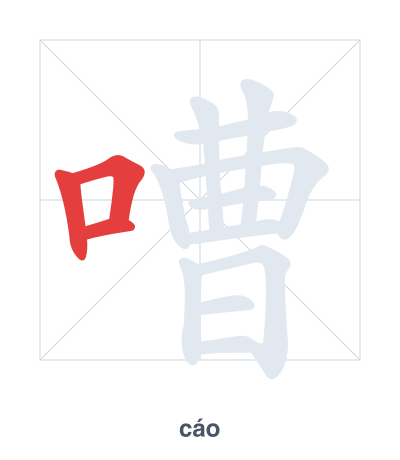
Stroke order practice for 嘈 - cáo

Practice Writing 嘈 (cáo)

Open Hanzi Writer to see the animated stroke order and practice writing 嘈 with real-time feedback.

The character (cáo) is written with 14 strokes. Follow the standard Chinese stroke order: top to bottom, left to right, outside before inside. The radical is one of its key components.

Practice the correct stroke order with the Hanzi Writer app to see animated stroke-by-stroke guidance with real-time feedback.

means Noisy..

Character
Pinyincáo (cao)
MeaningNoisy.
Strokes14
Radical
Difficulty4.2/5

嘈 combines the mouth radical (口) with 曹 (cáo, meaning 'group'), suggesting many mouths speaking at once — hence 'noisy'. The component 曹 itself depicts two bundles of grain (東) under a canopy, but here it primarily serves as a phonetic and semantic hint of a crowd.

💡 Memory Tip: Picture a crowded room where every mouth (口) is shouting over a group (曹) of noisy friends — total chaos, total 嘈.

cáo zá
Noisy; clamorous.
chǎo cáo
noisy and clamorous
cáo rǎng
To clamor; to make a racket.

这里环境很嘈杂。

zhè lǐ huán jìng hěn cáo zá

The environment here is very noisy.

外面非常吵嘈。

wài miàn fēi cháng chǎo cáo

It's very noisy outside.

别在这里嘈嚷。

bié zài zhè lǐ cáo rǎng

Don't make a noise here.

Character Pinyin Strokes Radical
(current) cáo 14
14
chì 12
12
Stroke order practice for 嘈 - cáo

Practice Writing 嘈 (cáo)

Open Hanzi Writer to see the animated stroke order and practice writing 嘈 with real-time feedback.

✨ Animated stroke order · Handwriting recognition · HSK-graded practice · Free to use

Frequently Asked Questions about 嘈

The left side is 口 (mouth), which often relates to sound or speech. The right side is 曹 (cáo), which provides the pronunciation and originally meant 'a group of people' – many people talking creates noise. Together, 口 + 曹 suggests the sound of many mouths, meaning noisy.

Characters with Radical 口

Other 14-Stroke Characters