猵 (biān) means "otter (archaic)" in Chinese. It has 12 strokes with the radical 犭.
Rated 4.2/5 in difficulty (advanced).
Appears in 3+ common words including 猵狙 (biān jū), 猵獭 (biān tǎ), 猵猵 (biān biān).
Due to its 12 strokes, Hanzi Writer's error detection shows 猵 requires focused practice — most learners need 10+ attempts for consistent accuracy.
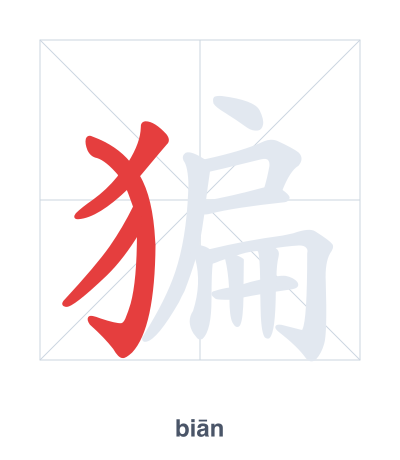
Open Hanzi Writer to see the animated stroke order and practice writing 猵 with real-time feedback.
The character 猵 (biān) is written with 12 strokes. Follow the standard Chinese stroke order: top to bottom, left to right, outside before inside. The radical 犭 is one of its key components.
Practice the correct stroke order with the Hanzi Writer app to see animated stroke-by-stroke guidance with real-time feedback.
猵 means otter (archaic).
猵 is a phono-semantic compound: the radical 犭 (dog/beast) signifies an animal, while 扁 (biǎn) provides the phonetic hint (its original meaning 'flat' also evokes the otter's sleek, flattened body). This archaic term specifically denoted the otter, a semiaquatic mammal once common in Chinese rivers.
💡 Memory Tip: Imagine a playful otter (犭) squishing itself super flat (扁) to wiggle through a narrow crack in the riverbank.
猵狙是一种古兽。
biān jū shì yī zhǒng gǔ shòu
The Pianju is an ancient mythical beast.
猵獭在水里游泳。
biān tǎ zài shuǐ lǐ yóu yǒng
The otter is swimming in the water.
猵猵在林中穿梭。
biān biān zài lín zhōng chuān suō
The animal is weaving through the forest.
Open Hanzi Writer to see the animated stroke order and practice writing 猵 with real-time feedback.
✨ Animated stroke order · Handwriting recognition · HSK-graded practice · Free to use
猵 is made of the radical 犭 (animal) on the left and the phonetic component 扁 (biǎn, meaning 'flat') on the right. The radical 犭 connects the character to animals, specifically an otter, which is an aquatic animal. The right side 扁 primarily gives the pronunciation biān, not a direct meaning hint.