狙 (jū) means "To lie in wait; sniper" in Chinese. It has 8 strokes with the radical 犭.
Rated 3.7/5 in difficulty (challenging).
Appears in 3+ common words including 狙击 (jū jī), 狙击枪 (jū jī qiāng), 狙击位 (jū jī wèi).
Due to its 8 strokes, Hanzi Writer's error detection shows 狙 requires focused practice — most learners need 10+ attempts for consistent accuracy.
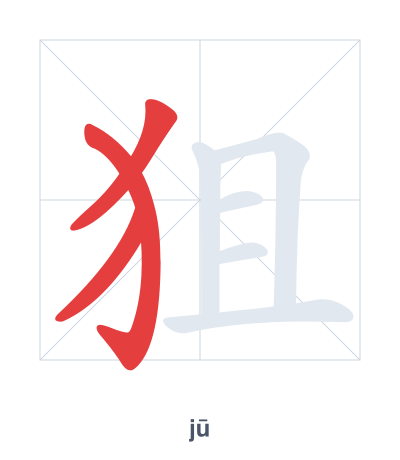
Open Hanzi Writer to see the animated stroke order and practice writing 狙 with real-time feedback.
The character 狙 (jū) is written with 8 strokes. Follow the standard Chinese stroke order: top to bottom, left to right, outside before inside. The radical 犭 is one of its key components.
Practice the correct stroke order with the Hanzi Writer app to see animated stroke-by-stroke guidance with real-time feedback.
狙 means To lie in wait; sniper.
The character 狙 combines the radical 犭 (animal) with 且 (jū), originally referring to a type of monkey known for lying in ambush. This behavior extended the meaning to 'lie in wait' and later 'sniper'.
💡 Memory Tip: Picture a cunning dog (犭) hiding behind a stone altar (且) to ambush its prey — that's the sniper's stance.
狙击手在远处观察。
jū jī shǒu zài yuǎn chù guān chá
The sniper is observing from a distance.
他拿着一把狙击枪。
tā ná zhe yī bǎ jū jī qiāng
He was holding a sniper rifle.
他找到了一个狙击位。
tā zhǎo dào le yí gè jū jī wèi
He found a sniper position.
Open Hanzi Writer to see the animated stroke order and practice writing 狙 with real-time feedback.
✨ Animated stroke order · Handwriting recognition · HSK-graded practice · Free to use
The character 狙 is a left-right structure. The left part 犭 is the animal radical, linking to hunting or wild animals. The right part 且 (qiě) provides a phonetic hint, and together the character suggests an animal lying in wait to ambush its prey.