嬖 (bì) means "To favor; a favorite (usually a concubine or official)" in Chinese. It has 16 strokes with the radical 女.
Rated 4.2/5 in difficulty (advanced).
Appears in 3+ common words including 嬖幸 (bì xìng), 嬖臣 (bì chén), 宠嬖 (chǒng bì).
Due to its 16 strokes, Hanzi Writer's error detection shows 嬖 requires focused practice — most learners need 10+ attempts for consistent accuracy.
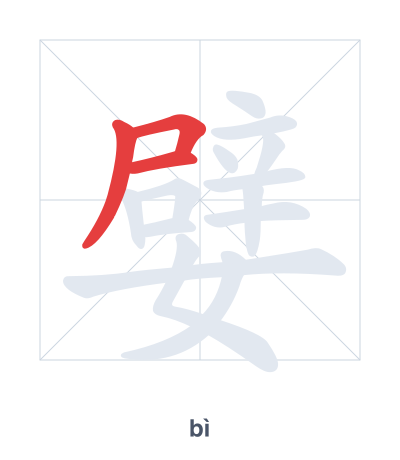
Open Hanzi Writer to see the animated stroke order and practice writing 嬖 with real-time feedback.
The character 嬖 (bì) is written with 16 strokes. Follow the standard Chinese stroke order: top to bottom, left to right, outside before inside. The radical 女 is one of its key components.
Practice the correct stroke order with the Hanzi Writer app to see animated stroke-by-stroke guidance with real-time feedback.
嬖 means To favor; a favorite (usually a concubine or official).
This is a phono-semantic compound combining the radical 女 (woman) with 辟 (bì), which originally meant 'to flatter or gain favor'. The character thus depicts a woman who is the object of favor, typically a concubine or favored official.
💡 Memory Tip: Think of a woman (女) who is the king's favorite; she is the 'bee's knees' (辟 sounds like 'bee'), so he always favors her.
他是皇帝的嬖幸。
tā shì huáng dì de bì xìng
He is the emperor's favorite.
历史上有许多嬖臣。
lì shǐ shàng yǒu xǔ duō bì chén
There were many favored sycophants in history.
他得到了国王的宠嬖。
tā dé dào le guó wáng de chǒng bì
He gained the king's favor.
Open Hanzi Writer to see the animated stroke order and practice writing 嬖 with real-time feedback.
✨ Animated stroke order · Handwriting recognition · HSK-graded practice · Free to use
The character 嬖 has the radical 女 (woman) at the bottom, indicating that the meaning involves a female. The top part 辟 (bì) provides the sound and also hints at authority or favor, so together it means "a woman who is favored" — often a concubine or favored official.