狈 (bèi) means "Bei (a legendary wolf-like animal)." in Chinese. It has 7 strokes with the radical 犭, and is HSK Level 7.
Rated 3.5/5 in difficulty (challenging).
Harder than 20% of HSK Level 7 characters.
Appears in 3+ common words including 狼狈 (láng bèi), 狈子 (bèi zi), 狼狈为奸 (láng bèi wéi jiān).
Due to its 7 strokes, Hanzi Writer's error detection shows 狈 requires focused practice — most learners need 10+ attempts for consistent accuracy.
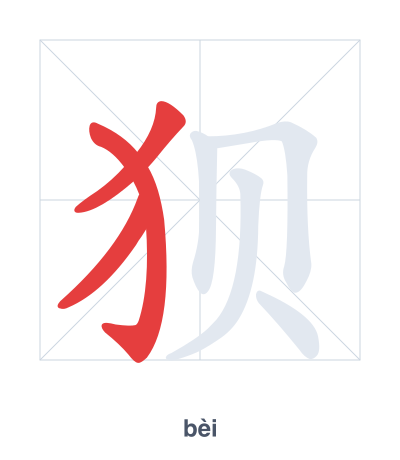
Open Hanzi Writer to see the animated stroke order and practice writing 狈 with real-time feedback.
The character 狈 (bèi) is written with 7 strokes. Follow the standard Chinese stroke order: top to bottom, left to right, outside before inside. The radical 犭 is one of its key components.
Practice the correct stroke order with the Hanzi Writer app to see animated stroke-by-stroke guidance with real-time feedback.
狈 means Bei (a legendary wolf-like animal)..
As an HSK Level 7 character, 狈 is an intermediate-level character.
狈 is a phono-semantic compound: the left side 犭 (dog radical) indicates it's an animal, while the right side 贝 (bèi, shell) provides the pronunciation. This character refers to a legendary wolf-like creature often paired with wolf (狼) in the idiom 狼狈, meaning 'in a difficult situation'—like a wolf with a shell on its back, slow and clumsy.
💡 Memory Tip: Picture a wolf (犭) carrying a large shell (贝) on its back, making it awkward and helpless—that's the legendary 狈.
他被雨淋得很狼狈。
tā bèi yǔ lín dé hěn láng bèi
He was caught in the rain and looked a mess.
传说中狈子非常聪明。
chuán shuō zhōng bèi zi fēi cháng cōng míng
Legend says the mythical 'Bei' (a wolf-like creature) is very clever.
他们两人狼狈为奸。
tā men liǎng rén láng bèi wéi jiān
The two of them act in collusion.
Open Hanzi Writer to see the animated stroke order and practice writing 狈 with real-time feedback.
✨ Animated stroke order · Handwriting recognition · HSK-graded practice · Free to use
狈 is composed of the radical 犭 on the left and the phonetic component 贝 on the right. The radical 犭 indicates a dog or wolf-like animal, while 贝 provides the pronunciation bèi. Together they form a character for a legendary wolf-like creature.