镑 (bàng) means "Pound (currency)" in Chinese. It has 15 strokes with the radical 钅, and is HSK Level 7.
Rated 4.2/5 in difficulty (advanced).
Harder than 95% of HSK Level 7 characters.
Appears in 3+ common words including 英镑 (yīng bàng), 换镑 (huàn bàng), 几镑 (jǐ bàng).
Due to its 15 strokes, Hanzi Writer's error detection shows 镑 requires focused practice — most learners need 10+ attempts for consistent accuracy.
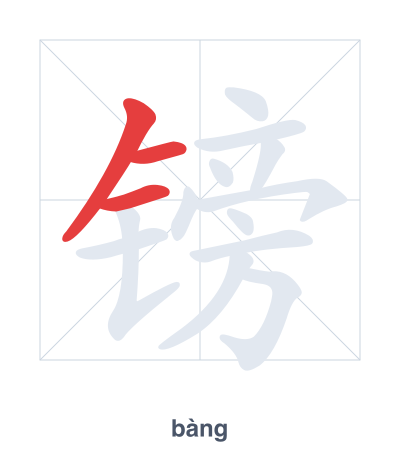
Open Hanzi Writer to see the animated stroke order and practice writing 镑 with real-time feedback.
The character 镑 (bàng) is written with 15 strokes. Follow the standard Chinese stroke order: top to bottom, left to right, outside before inside. The radical 钅 is one of its key components.
Practice the correct stroke order with the Hanzi Writer app to see animated stroke-by-stroke guidance with real-time feedback.
镑 means Pound (currency).
As an HSK Level 7 character, 镑 is an intermediate-level character.
镑 is a phono-semantic compound character. The left side, 钅 (jīn), is the radical for metal, indicating that this character relates to metal, which historically was used for coins. The right side, 旁 (páng), provides the pronunciation and also hints at 'side' or 'beside', but in this context it mainly serves as a phonetic component. Together, they form a character that means a unit of currency, specifically the pound.
💡 Memory Tip: Imagine a metal coin (钅) with a pound sign (£) on it, sitting next to (旁) a scale that weighs gold. The metal reminds you it's about money, and the '旁' sounds like 'pound' to help you remember the sound.
我有十英镑现金。
wǒ yǒu shí yīng bàng xiàn jīn
I have ten pounds in cash.
我去银行换英镑。
wǒ qù yín háng huàn yīng bàng
I'm going to the bank to exchange for pounds.
这本书要几镑钱?
zhè běn shū yào jǐ bàng qián
How many pounds does this book cost?
Open Hanzi Writer to see the animated stroke order and practice writing 镑 with real-time feedback.
✨ Animated stroke order · Handwriting recognition · HSK-graded practice · Free to use
镑 is composed of two parts: the radical 钅 (metal) and the phonetic component 旁 (páng). The radical indicates that the character is associated with metal, which is historically linked to coins and currency. The phonetic part gives the approximate pronunciation 'bang'. So the structure tells you it's a metal-related word pronounced 'bang', which is the pound currency.