锘 (nuò) means "Nobelium" in Chinese. It has 13 strokes with the radical 钅.
Rated 4.2/5 in difficulty (advanced).
Appears in 3+ common words including 锘元素 (nuò yuán sù), 锘原子 (nuò yuán zi), 发现锘 (fā xiàn nuò).
Due to its 13 strokes, Hanzi Writer's error detection shows 锘 requires focused practice — most learners need 10+ attempts for consistent accuracy.
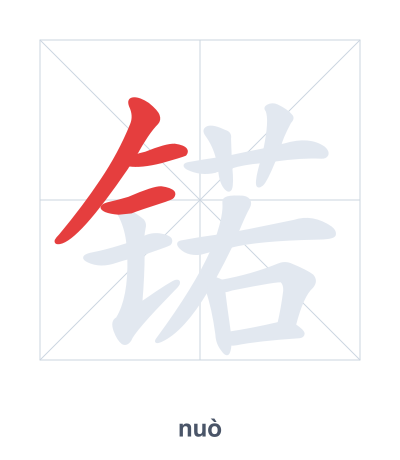
Open Hanzi Writer to see the animated stroke order and practice writing 锘 with real-time feedback.
The character 锘 (nuò) is written with 13 strokes. Follow the standard Chinese stroke order: top to bottom, left to right, outside before inside. The radical 钅 is one of its key components.
Practice the correct stroke order with the Hanzi Writer app to see animated stroke-by-stroke guidance with real-time feedback.
锘 means Nobelium.
锘 is a phono-semantic compound. The radical 钅 (metal) indicates it is a metallic element, while 若 (ruò) provides the phonetic component, approximating the sound 'nuò'. It was created in modern times to represent the synthetic element Nobelium (No), named after Alfred Nobel.
💡 Memory Tip: Imagine a golden (钅) medal shaped like the word 'NO' (Nobelium) hanging on a ribbon that looks like the character 若.
锘元素很难发现。
nuò yuán sù hěn nán fā xiàn
Nobelium is very difficult to discover.
锘原子很不稳定。
nuò yuán zi hěn bù wěn dìng
Nobelium atoms are very unstable.
科学家发现了锘。
kē xué jiā fā xiàn le nuò
Scientists discovered nobelium.
Open Hanzi Writer to see the animated stroke order and practice writing 锘 with real-time feedback.
✨ Animated stroke order · Handwriting recognition · HSK-graded practice · Free to use
The character 锘 is made of two parts: the left radical 钅 (jīn, meaning 'gold' or 'metal') and the right part 若 (ruò). Since nobelium is a metallic chemical element, the metal radical 钅 directly connects to its classification as a metal.