锖 (qiāng) means "Tarnish (on metal)" in Chinese. It has 13 strokes with the radical 钅.
Rated 4.2/5 in difficulty (advanced).
Appears in 3+ common words including 锖色 (qiāng sè), 锖斑 (qiāng bān), 锖化 (qiāng huà).
Due to its 13 strokes, Hanzi Writer's error detection shows 锖 requires focused practice — most learners need 10+ attempts for consistent accuracy.
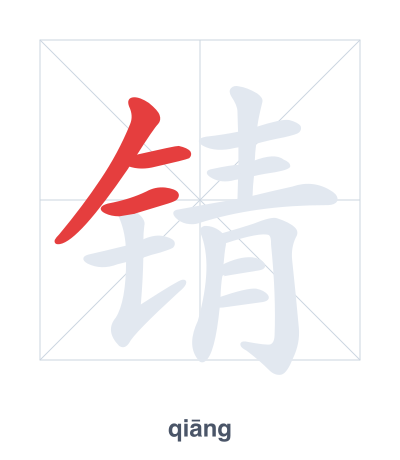
Open Hanzi Writer to see the animated stroke order and practice writing 锖 with real-time feedback.
The character 锖 (qiāng) is written with 13 strokes. Follow the standard Chinese stroke order: top to bottom, left to right, outside before inside. The radical 钅 is one of its key components.
Practice the correct stroke order with the Hanzi Writer app to see animated stroke-by-stroke guidance with real-time feedback.
锖 means Tarnish (on metal).
锖 is a compound character combining the metal radical 钅 (jīn) with 青 (qīng, meaning 'green/blue'). The bluish-green discoloration that appears on tarnished metals, such as the patina on bronze, inspired this composition: metal (钅) turning the color of green/blue (青).
💡 Memory Tip: Imagine a shiny gold ring (钅) slowly turning green (青) like the Statue of Liberty—that's tarnish on metal!
金属表面有锖色。
jīn shǔ biǎo miàn yǒu qiāng sè
There is tarnish on the metal surface.
这块铁上有锖斑。
zhè kuài tiě shàng yǒu qiāng bān
There are tarnish spots on this iron.
金属发生了锖化。
jīn shǔ fā shēng le qiāng huà
The metal has tarnished.
Open Hanzi Writer to see the animated stroke order and practice writing 锖 with real-time feedback.
✨ Animated stroke order · Handwriting recognition · HSK-graded practice · Free to use
锖 combines the radical 钅 (metal/gold) with 青 (qīng, meaning blue/green), which also gives a hint to its pronunciation. The metal radical suggests the character relates to metals, while 青 evokes the blue-green discoloration that appears on tarnished metal surfaces.