唵 (ǎn) means "Om (mantra) / Huh?" in Chinese. It has 11 strokes with the radical 口.
Rated 4.2/5 in difficulty (advanced).
Appears in 2+ common words including 唵 (ǎn), 唵嘛呢叭咪吽 (ǎn ma ne ba mī hōng).
Due to its 11 strokes, Hanzi Writer's error detection shows 唵 requires focused practice — most learners need 10+ attempts for consistent accuracy.
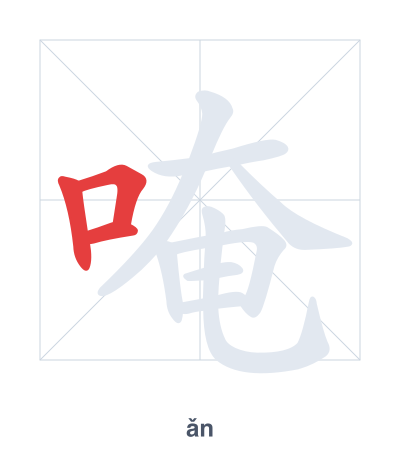
Open Hanzi Writer to see the animated stroke order and practice writing 唵 with real-time feedback.
The character 唵 (ǎn) is written with 11 strokes. Follow the standard Chinese stroke order: top to bottom, left to right, outside before inside. The radical 口 is one of its key components.
Practice the correct stroke order with the Hanzi Writer app to see animated stroke-by-stroke guidance with real-time feedback.
唵 means Om (mantra) / Huh?.
唵 is a phono-semantic compound; the mouth radical (口) indicates it relates to sound or speech, while 奄 (yǎn) provides pronunciation and also suggests 'to cover'—evoking the deep, closed-lip humming of the mantra 'Om' or a muffled interjection like 'Huh?'.
💡 Memory Tip: Picture a mouth (口) uttering 'Om' while a huge (大) electric eel (电) zaps it, making you exclaim 'Huh?' in surprise.
唵,我知道了。
ǎn wǒ zhī dào le
Oh, I see.
他在念唵嘛呢叭咪吽。
tā zài niàn ǎn ma ne ba mī hōng
He is chanting 'Om Mani Padme Hum'.
唵,你说什么?
ǎn nǐ shuō shén me
Huh? What did you say?
Open Hanzi Writer to see the animated stroke order and practice writing 唵 with real-time feedback.
✨ Animated stroke order · Handwriting recognition · HSK-graded practice · Free to use
The character 唵 combines the mouth radical 口 on the left with 奄 on the right. 口 indicates that the meaning involves sound or speech, while 奄 provides pronunciation and originally means "to cover" — together suggesting a covered or sacred utterance like a mantra.