Hanzi Writer

How to Write 嗌 (ài) — Meaning “Throat; to choke”

ài 13 strokes Radical: 口

嗌 (ài) means "Throat; to choke" in Chinese. It has 13 strokes with the radical 口.

Rated 4.2/5 in difficulty (advanced).

Appears in 3+ common words including 嗌干 (ài gàn), 嗌塞 (ài sāi), 嗌喔 (ài ō).

Due to its 13 strokes, Hanzi Writer's error detection shows 嗌 requires focused practice — most learners need 10+ attempts for consistent accuracy.
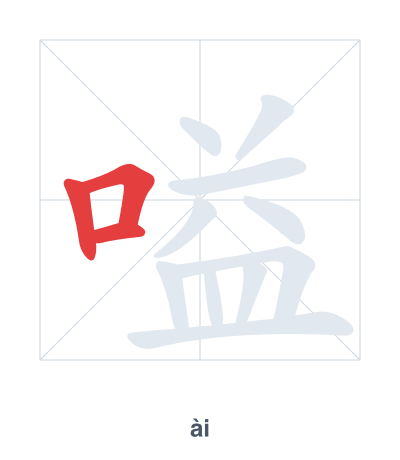
Stroke order practice for 嗌 - ài

Practice Writing 嗌 (ài)

Open Hanzi Writer to see the animated stroke order and practice writing 嗌 with real-time feedback.

The character (ài) is written with 13 strokes. Follow the standard Chinese stroke order: top to bottom, left to right, outside before inside. The radical is one of its key components.

Practice the correct stroke order with the Hanzi Writer app to see animated stroke-by-stroke guidance with real-time feedback.

means Throat; to choke.

Character
Pinyinài (ai)
MeaningThroat; to choke
Strokes13
Radical
Difficulty4.2/5

嗌 is a compound character combining the 'mouth' radical (口) indicating the throat or oral cavity, and the phonetic component 益 (yì, originally meaning 'to overflow'). Together, they literally depict the mouth or throat being obstructed or 'overflowed' by food, causing choking.

💡 Memory Tip: Picture a person with a big mouth (口) trying to swallow an overflowing pile of grain (益)—their throat is blocked and they start to choke.

ài gàn
Dry throat
ài sāi
To be choked up; obstruction in the throat
ài ō
Crowing sound of a rooster

他觉得喉咙有些嗌干。

tā jué de hóu lóng yǒu xiē ài gàn

He felt his throat was a bit dry.

他感到喉咙嗌塞。

tā gǎn dào hóu lóng ài sāi

He felt a blockage in his throat.

远处传来嗌喔的叫声。

yuǎn chù chuán lái ài ō de jiào shēng

A crowing sound came from the distance.

Character Pinyin Strokes Radical
(current) ài 13
14
fěng 11
jìn 11
Stroke order practice for 嗌 - ài

Practice Writing 嗌 (ài)

Open Hanzi Writer to see the animated stroke order and practice writing 嗌 with real-time feedback.

✨ Animated stroke order · Handwriting recognition · HSK-graded practice · Free to use

Frequently Asked Questions about 嗌

嗌 is composed of the radical 口 (mouth) on the left and the phonetic component 益 (yì) on the right. The mouth radical indicates that the character relates to the throat or mouth area, while 益 suggests the sound. Together, they form a character meaning 'throat' or 'to choke', as in something blocking the mouth or throat.

Characters with Radical 口

Other 13-Stroke Characters