撙 (zǔn) means "to economize; to restrain" in Chinese. It has 15 strokes with the radical 扌.
Rated 4.2/5 in difficulty (advanced).
Appears in 3+ common words including 撙节 (zǔn jié), 撙养 (zǔn yǎng), 撙减 (zǔn jiǎn).
Due to its 15 strokes, Hanzi Writer's error detection shows 撙 requires focused practice — most learners need 10+ attempts for consistent accuracy.
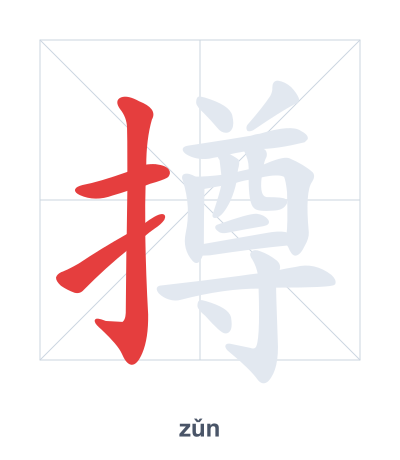
Open Hanzi Writer to see the animated stroke order and practice writing 撙 with real-time feedback.
The character 撙 (zǔn) is written with 15 strokes. Follow the standard Chinese stroke order: top to bottom, left to right, outside before inside. The radical 扌 is one of its key components.
Practice the correct stroke order with the Hanzi Writer app to see animated stroke-by-stroke guidance with real-time feedback.
撙 means to economize; to restrain.
撙 is a phono-semantic compound with the hand radical 扌 indicating an action, and 尊 (zūn) providing the sound and a hint of meaning—since 尊 originally depicted a ritual wine vessel treated with reverence, the hand carefully handling or restraining something suggests economizing or holding back.
💡 Memory Tip: Imagine your hand (扌) carefully holding a precious vase (尊) to avoid wasting a single drop, forcing you to economize and restrain your spending.
我们要撙节开支。
wǒ men yào zǔn jié kāi zhī
We need to cut down on expenses.
撙养身体很重要。
zǔn yǎng shēn tǐ hěn zhòng yào
Taking care of one's health is very important.
费用需要撙减。
fèi yòng xū yào zǔn jiǎn
Expenses need to be cut down.
Open Hanzi Writer to see the animated stroke order and practice writing 撙 with real-time feedback.
✨ Animated stroke order · Handwriting recognition · HSK-graded practice · Free to use
撙 is made of the hand radical 扌 on the left and 尊 (zūn, meaning 'respect') on the right. The hand radical shows that the character involves an action, while 尊 adds the idea of being careful or respectful, which together suggest the careful action of economizing or restraining.