资 (zī) means "resources; capital; expenses" in Chinese. It has 10 strokes with the radical 贝, and is HSK Level 3.
Rated 4.2/5 in difficulty (advanced).
Harder than 95% of HSK Level 3 characters.
Appears in 3+ common words including 资料 (zī liào), 工资 (gōng zī), 投资 (tóu zī).
Due to its 10 strokes, Hanzi Writer's error detection shows 资 requires focused practice — most learners need 10+ attempts for consistent accuracy.
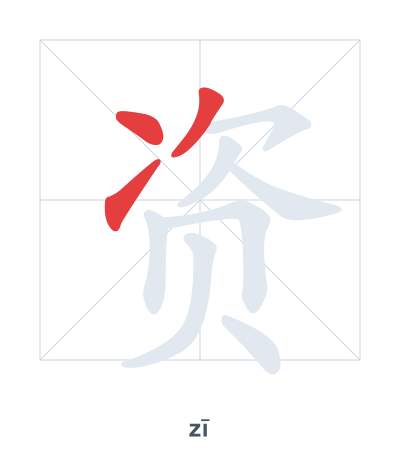
Open Hanzi Writer to see the animated stroke order and practice writing 资 with real-time feedback.
The character 资 (zī) is written with 10 strokes. Follow the standard Chinese stroke order: top to bottom, left to right, outside before inside. The radical 贝 is one of its key components.
Practice the correct stroke order with the Hanzi Writer app to see animated stroke-by-stroke guidance with real-time feedback.
资 means resources; capital; expenses.
As an HSK Level 3 character, 资 is an intermediate-level character.
资 is a phono-semantic compound combining 贝 (shell money, symbol of wealth) with 次 (pronounced zī, providing sound and hinting at 'next' or 'accumulated'). The character originally denoted accumulated wealth or financial resources, like capital set aside for future use.
💡 Memory Tip: Picture a pile of cash (贝) under a sign reading 'Next' (次), reminding you that capital is money reserved for upcoming expenses.
请给我一份学习资料。
qǐng gěi wǒ yī fèn xué xí zī liào
Please give me some study materials.
我每个月五号发工资。
wǒ měi gè yuè wǔ hào fā gōng zī
I get paid on the fifth of every month.
他投资了一家新公司。
tā tóu zī le yī jiā xīn gōng sī
He invested in a new company.
Open Hanzi Writer to see the animated stroke order and practice writing 资 with real-time feedback.
✨ Animated stroke order · Handwriting recognition · HSK-graded practice · Free to use
资 is composed of 次 (cì) on top and 贝 (bèi) on the bottom. The radical 贝 means "shell" or "money," which connects to the meaning of resources and capital. The top part 次 gives the pronunciation "zī" and also hints at the idea of "next" or "second" resources.