桩 (zhuāng) means "Stake / Pile / Post" in Chinese. It has 10 strokes with the radical 木, and is HSK Level 7.
Rated 4.2/5 in difficulty (advanced).
Harder than 63% of HSK Level 7 characters.
Appears in 3+ common words including 木桩 (mù zhuāng), 一桩喜事 (yī zhuāng xǐ shì), 桩基 (zhuāng jī).
Due to its 10 strokes, Hanzi Writer's error detection shows 桩 requires focused practice — most learners need 10+ attempts for consistent accuracy.
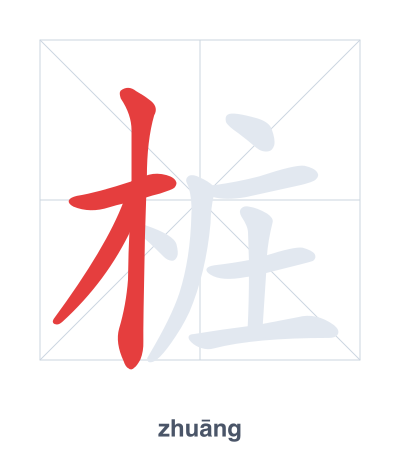
Open Hanzi Writer to see the animated stroke order and practice writing 桩 with real-time feedback.
The character 桩 (zhuāng) is written with 10 strokes. Follow the standard Chinese stroke order: top to bottom, left to right, outside before inside. The radical 木 is one of its key components.
Practice the correct stroke order with the Hanzi Writer app to see animated stroke-by-stroke guidance with real-time feedback.
桩 means Stake / Pile / Post.
As an HSK Level 7 character, 桩 is an intermediate-level character.
桩 combines the radical 木 (wood/tree) with 庄 (village/farm). The wooden post or stake was used to mark boundaries or support structures in villages, so a 'wooden village marker' visually represents a pile or stake.
💡 Memory Tip: Imagine a wooden post (木) standing tall in the center of a village (庄) to mark the main meeting point — that's your stake.
地上钉了一个木桩。
dì shàng dīng le yí gè mù zhuāng
A wooden stake was driven into the ground.
帮小王办好这一桩喜事是王大妈今年最大的心愿。
bāng xiǎo wáng bàn hǎo zhè yī zhuāng xǐ shì shì wáng dà mā jīn nián zuì dà de xīn yuàn 。
Helping Xiao Wang with this happy event is Auntie Wang's biggest wish this year.
工人在打桩基。
gōng rén zài dǎ zhuāng jī
The worker is driving piles for the foundation.
Open Hanzi Writer to see the animated stroke order and practice writing 桩 with real-time feedback.
✨ Animated stroke order · Handwriting recognition · HSK-graded practice · Free to use
桩 is composed of the radical 木 (wood) on the left and 庄 (zhuāng, village or farm) on the right. The 木 radical gives a clear clue that the character relates to wood, while 庄 provides the pronunciation. Together, they create the meaning 'stake' or 'post,' originally a wooden post used in construction or land marking.