夏 (xià) means "summer" in Chinese. It has 10 strokes with the radical 夂, and is HSK Level 2.
Rated 3.4/5 in difficulty (challenging).
Harder than 58% of HSK Level 2 characters.
Appears in 3+ common words including 夏天 (xià tiān), 夏季 (xià jì), 夏令营 (xià lìng yíng).
Due to its 10 strokes, Hanzi Writer's error detection shows 夏 requires focused practice — most learners need 10+ attempts for consistent accuracy.
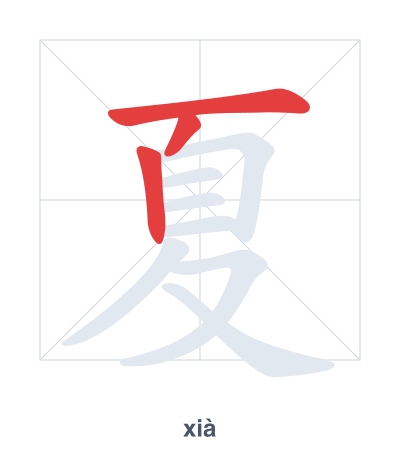
Open Hanzi Writer to see the animated stroke order and practice writing 夏 with real-time feedback.
The character 夏 (xià) is written with 10 strokes. Follow the standard Chinese stroke order: top to bottom, left to right, outside before inside. The radical 夂 is one of its key components.
Practice the correct stroke order with the Hanzi Writer app to see animated stroke-by-stroke guidance with real-time feedback.
夏 means summer.
As an HSK Level 2 character, 夏 is among the first characters beginners learn.
The ancient form of 夏 showed a person with a large head, arms, and feet, likely depicting a dancing figure or a person in ceremonial attire, symbolizing the lively, active nature of summer. Over time, it evolved into a compound with the radical 夂 (to go slowly) and the element 自 (self), though its core meaning as 'summer' is tied to the season of growth and movement.
💡 Memory Tip: Picture a person with a big sun hat (the top part of 夏) and two legs (夂) walking fast in the summer heat, sweating under the sun.
夏天天气非常热。
xià tiān tiān qì fēi cháng rè
The weather is very hot in summer.
夏季经常下大雨。
xià jì jīng cháng xià dà yǔ
It often rains heavily in summer.
我参加了学校的夏令营。
wǒ cān jiā le xué xiào de xià lìng yíng
I participated in the school summer camp.
Open Hanzi Writer to see the animated stroke order and practice writing 夏 with real-time feedback.
✨ Animated stroke order · Handwriting recognition · HSK-graded practice · Free to use
夏 is composed of a top part that looks like a face or head (from an ancient form meaning 'person'), a middle part 自 (originally 'nose'), and a bottom part 夂 (walking slowly). Together, they suggest a person with a big nose or face, possibly representing a heat-related image, though the modern meaning 'summer' is conventional. The radical 夂 (walking) hints at the season's progression, but the character is best learned as a whole unit.