枝 (zhī) means "branch; twig" in Chinese. It has 8 strokes with the radical 木, and is HSK Level 6.
Rated 3.7/5 in difficulty (challenging).
Harder than 30% of HSK Level 6 characters.
Appears in 3+ common words including 树枝 (shù zhī), 一枝花 (yī zhī huā), 枝叶 (zhī yè).
Due to its 8 strokes, Hanzi Writer's error detection shows 枝 requires focused practice — most learners need 10+ attempts for consistent accuracy.
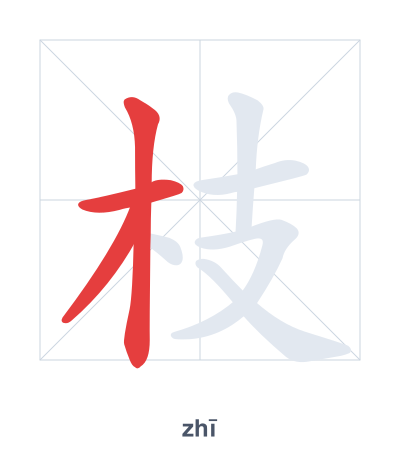
Open Hanzi Writer to see the animated stroke order and practice writing 枝 with real-time feedback.
The character 枝 (zhī) is written with 8 strokes. Follow the standard Chinese stroke order: top to bottom, left to right, outside before inside. The radical 木 is one of its key components.
Practice the correct stroke order with the Hanzi Writer app to see animated stroke-by-stroke guidance with real-time feedback.
枝 means branch; twig.
As an HSK Level 6 character, 枝 is an intermediate-level character.
枝 is a phono-semantic compound: the radical 木 (tree) indicates the meaning 'branch', while the component 支 (zhī) not only provides pronunciation but originally depicted a hand holding a branch, reinforcing the idea of a branch growing from a tree.
💡 Memory Tip: Picture a tree (木) with a branch (支) reaching out like an arm holding a twig.
树枝上有一只鸟。
shù zhī shàng yǒu yī zhī niǎo
There is a bird on the branch.
桌上有一枝花。
zhuō shàng yǒu yī zhī huā
There is a flower on the table.
树的枝叶很茂盛。
shù de zhī yè hěn mào shèng
The tree's foliage is very lush.
Open Hanzi Writer to see the animated stroke order and practice writing 枝 with real-time feedback.
✨ Animated stroke order · Handwriting recognition · HSK-graded practice · Free to use
枝 combines the radical 木 (tree) on the left with the phonetic component 支 (zhī) on the right. The tree radical suggests wood or a tree part, while 支 adds sound and also carries the idea of 'to support' or 'branch off', together forming the meaning of a tree branch or twig.