耋 (dié) means "Person in their 70s or 80s / Very old" in Chinese. It has 12 strokes with the radical 耂.
Rated 4.2/5 in difficulty (advanced).
Appears in 3+ common words including 耄耋 (mào dié), 耋老 (dié lǎo), 耋年 (dié nián).
Due to its 12 strokes, Hanzi Writer's error detection shows 耋 requires focused practice — most learners need 10+ attempts for consistent accuracy.
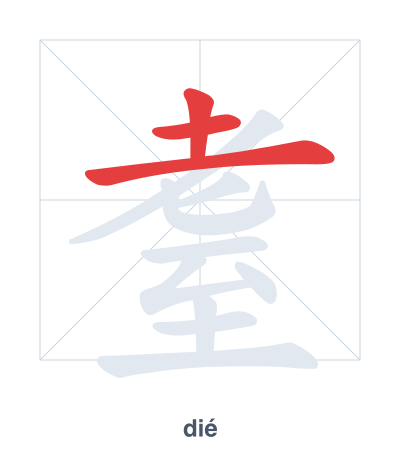
Open Hanzi Writer to see the animated stroke order and practice writing 耋 with real-time feedback.
The character 耋 (dié) is written with 12 strokes. Follow the standard Chinese stroke order: top to bottom, left to right, outside before inside. The radical 耂 is one of its key components.
Practice the correct stroke order with the Hanzi Writer app to see animated stroke-by-stroke guidance with real-time feedback.
耋 means Person in their 70s or 80s / Very old.
| Character | 耋 |
| Pinyin | dié (die) |
| Meaning | Person in their 70s or 80s / Very old |
| Strokes | 12 |
| Radical | 耂 |
| Difficulty | 4.2/5 |
The character 耋 combines the radical 耂 (a variant of 老, meaning 'old') on top with 至 (meaning 'to reach' or 'arrive') below. Together, they signify 'reaching an advanced age,' specifically one's 70s or 80s. The top component visually depicts an elderly person with bent posture and a cane, while 至 reinforces the idea of arriving at that stage of life.
💡 Memory Tip: Picture an old person leaning on a cane (耂) who has just reached (至) the milestone of their 70s or 80s.
祝您耄耋长寿。
zhù nín mào dié cháng shòu
Wishing you a long life into your eighties and nineties.
耋老之年要多休息。
dié lǎo zhī nián yào duō xiū xī
One should rest more in their advanced years.
他已步入耋年。
tā yǐ bù rù dié nián
He has entered his old age.
Open Hanzi Writer to see the animated stroke order and practice writing 耋 with real-time feedback.
✨ Animated stroke order · Handwriting recognition · HSK-graded practice · Free to use
The character 耋 is composed of the radical 耂 (old person) on top and 至 (to arrive) below. The radical 耂 provides the meaning of old age, and 至 suggests reaching an extreme point. Together, they indicate a person who has arrived at a very old age, specifically their 70s or 80s.