考 (kǎo) means "To test, examine, or study." in Chinese. It has 6 strokes with the radical 耂, and is HSK Level 1.
Rated 2.7/5 in difficulty (moderate).
Harder than 47% of HSK Level 1 characters.
Appears in 3+ common words including 考试 (kǎo shì), 考虑 (kǎo lǜ), 考查 (kǎo chá).
Hanzi Writer's stroke validation shows learners typically need 5-8 attempts to write 考 with correct proportion and order.
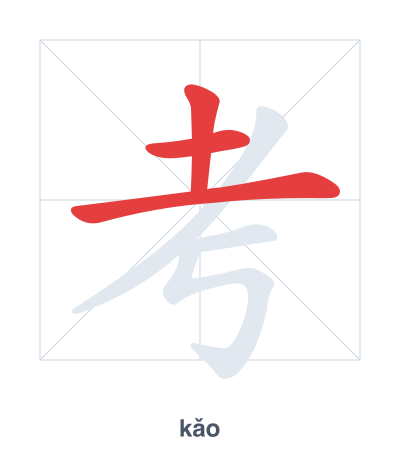
Open Hanzi Writer to see the animated stroke order and practice writing 考 with real-time feedback.
The character 考 (kǎo) is written with 6 strokes. Follow the standard Chinese stroke order: top to bottom, left to right, outside before inside. The radical 耂 is one of its key components.
Practice the correct stroke order with the Hanzi Writer app to see animated stroke-by-stroke guidance with real-time feedback.
考 means To test, examine, or study..
As an HSK Level 1 character, 考 is among the first characters beginners learn.
考 originally depicted an old person (耂) leaning on a cane (丂), meaning 'aged'. Over time, it was borrowed to mean 'to test' or 'examine', perhaps from the idea of scrutinizing someone's knowledge like an elder verifying the truth.
💡 Memory Tip: Picture an old man (耂) using a crooked cane (丂) to tap on exam papers as he quizzes a student.
我明天有考试。
wǒ míng tiān yǒu kǎo shì
I have an exam tomorrow.
请你认真考虑一下。
qǐng nǐ rèn zhēn kǎo lǜ yī xià
Please consider it seriously.
老师在考查作业。
lǎo shī zài kǎo chá zuò yè
The teacher is checking the homework.
Open Hanzi Writer to see the animated stroke order and practice writing 考 with real-time feedback.
✨ Animated stroke order · Handwriting recognition · HSK-graded practice · Free to use
The character 考 is made of two parts: the radical 耂 on top, which originally means 'old', and the component 丂 below, which gives pronunciation. Although 考 once meant 'old person', it is now used for testing and examining.