咤 (zhà) means "to shout; to scold" in Chinese. It has 9 strokes with the radical 口.
Rated 4/5 in difficulty (challenging).
Appears in 3+ common words including 叱咤 (chì zhà), 咤异 (zhà yì), 咤叹 (zhà tàn).
Due to its 9 strokes, Hanzi Writer's error detection shows 咤 requires focused practice — most learners need 10+ attempts for consistent accuracy.
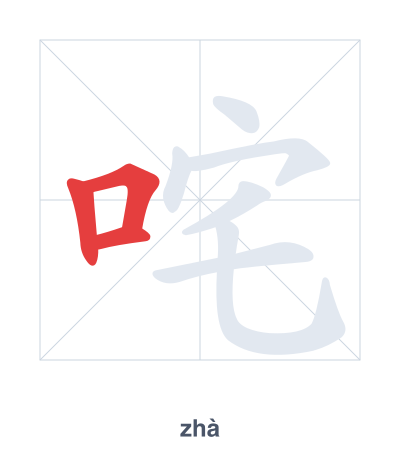
Open Hanzi Writer to see the animated stroke order and practice writing 咤 with real-time feedback.
The character 咤 (zhà) is written with 9 strokes. Follow the standard Chinese stroke order: top to bottom, left to right, outside before inside. The radical 口 is one of its key components.
Practice the correct stroke order with the Hanzi Writer app to see animated stroke-by-stroke guidance with real-time feedback.
咤 means to shout; to scold.
咤 is a phonetic-semantic compound. The mouth radical (口) indicates the action of speaking or shouting, while the right component (乇) provides the pronunciation and originally depicted a plant sprouting, symbolizing a sudden outburst of sound.
💡 Memory Tip: Picture a mouth (口) with a long wagging tongue (乇) shouting angrily at someone.
他叱咤风云。
tā chì zhà fēng yún
He is a powerful figure who commands the wind and clouds.
这件事令人咤异。
zhè jiàn shì lìng rén zhà yì
This matter is astonishing.
他咤叹不已。
tā zhà tàn bù yǐ
He sighed and exclaimed repeatedly.
Open Hanzi Writer to see the animated stroke order and practice writing 咤 with real-time feedback.
✨ Animated stroke order · Handwriting recognition · HSK-graded practice · Free to use
咤 is made of the radical 口 (mouth) on the left and 宅 (zhái, house) on the right. The mouth radical suggests sound or speech, while 宅 provides the pronunciation. Together they create a character meaning a loud shout or scold, as if shouting from a house.