叱 (chì) means "to scold; to shout at" in Chinese. It has 5 strokes with the radical 口.
Rated 2.9/5 in difficulty (moderate).
Appears in 3+ common words including 叱责 (chì zé), 怒叱 (nù chì), 叱咤 (chì zhà).
Hanzi Writer's stroke validation shows learners typically need 5-8 attempts to write 叱 with correct proportion and order.
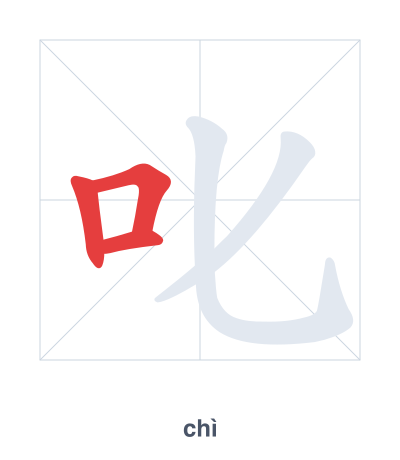
Open Hanzi Writer to see the animated stroke order and practice writing 叱 with real-time feedback.
The character 叱 (chì) is written with 5 strokes. Follow the standard Chinese stroke order: top to bottom, left to right, outside before inside. The radical 口 is one of its key components.
Practice the correct stroke order with the Hanzi Writer app to see animated stroke-by-stroke guidance with real-time feedback.
叱 means to scold; to shout at.
This compound character combines the radical 口 (mouth) with the phonetic component 七 (qī), suggesting a sharp, cutting sound emitted from the mouth to scold or shout at someone.
💡 Memory Tip: Picture a mouth (口) shooting out a sharp 'chi!' like a cross-shaped blade (七) to scold someone harshly.
老师叱责了学生。
lǎo shī chì zé le xué shēng
The teacher rebuked the student.
他怒叱那个坏人。
tā nù chì nà ge huài rén
He angrily rebuked the bad person.
他在商场叱咤风云。
tā zài shāng chǎng chì zhà fēng yún
He is a powerful figure in the business world.
Open Hanzi Writer to see the animated stroke order and practice writing 叱 with real-time feedback.
✨ Animated stroke order · Handwriting recognition · HSK-graded practice · Free to use
叱 is composed of the radical 口 (mouth, on the left) and the component 匕 (spoon or dagger, on the right). The mouth radical directly indicates that the character involves speaking or shouting, while the right side suggests a sharp or forceful action, together meaning to scold or shout at someone.