咂 (zā) means "to smack one's lips; to sip" in Chinese. It has 8 strokes with the radical 口.
Rated 3.7/5 in difficulty (challenging).
Appears in 3+ common words including 咂嘴 (zā zuǐ), 咂摸 (zā mō), 咂一口 (zā yī kǒu).
Due to its 8 strokes, Hanzi Writer's error detection shows 咂 requires focused practice — most learners need 10+ attempts for consistent accuracy.
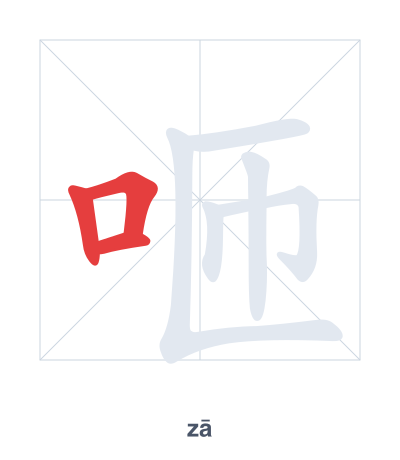
Open Hanzi Writer to see the animated stroke order and practice writing 咂 with real-time feedback.
The character 咂 (zā) is written with 8 strokes. Follow the standard Chinese stroke order: top to bottom, left to right, outside before inside. The radical 口 is one of its key components.
Practice the correct stroke order with the Hanzi Writer app to see animated stroke-by-stroke guidance with real-time feedback.
咂 means to smack one's lips; to sip.
咂 combines the mouth radical 口 with 匝 (zā), which originally meant 'to encircle' and provides the sound. The mouth and circling together evoke the action of pursing or smacking one's lips while sipping or tasting something.
💡 Memory Tip: Imagine your mouth (口) making a circular motion like the top part of 匝 as you smack your lips after a tasty sip.
他吃得津津有味,直咂嘴。
tā chī dé jīn jīn yǒu wèi zhí zā zuǐ
He ate with great relish, smacking his lips.
你好好咂摸一下他的话。
nǐ hǎo hǎo zā mō yī xià tā de huà
Think carefully about what he said.
他咂了一口小酒。
tā zā le yī kǒu xiǎo jiǔ
He took a sip of liquor.
Open Hanzi Writer to see the animated stroke order and practice writing 咂 with real-time feedback.
✨ Animated stroke order · Handwriting recognition · HSK-graded practice · Free to use
咂 is composed of the radical 口 (mouth) on the left and the phonetic component 匝 (zā) on the right. The mouth radical indicates actions involving the mouth, like smacking lips or sipping, while 匝 provides the sound.