螈 (yuán) means "Newt / Salamander" in Chinese. It has 16 strokes with the radical 虫.
Rated 4.2/5 in difficulty (advanced).
Appears in 3+ common words including 蝾螈 (róng yuán), 陆螈 (lù yuán), 这种螈 (zhè zhǒng yuán).
Due to its 16 strokes, Hanzi Writer's error detection shows 螈 requires focused practice — most learners need 10+ attempts for consistent accuracy.
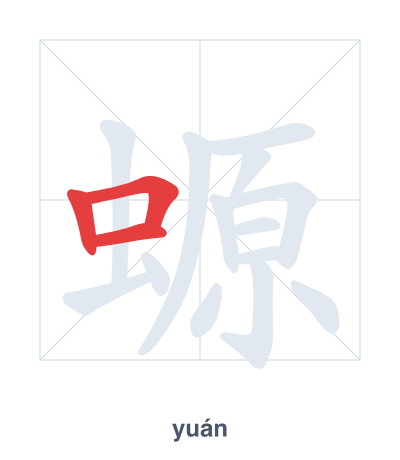
Open Hanzi Writer to see the animated stroke order and practice writing 螈 with real-time feedback.
The character 螈 (yuán) is written with 16 strokes. Follow the standard Chinese stroke order: top to bottom, left to right, outside before inside. The radical 虫 is one of its key components.
Practice the correct stroke order with the Hanzi Writer app to see animated stroke-by-stroke guidance with real-time feedback.
螈 means Newt / Salamander.
螈 is a phono-semantic compound: the left radical 虫 (chóng) indicates it is a type of reptile or amphibian, and the right component 原 (yuán) provides the pronunciation and also hints at 'origin' or 'source,' referencing how salamanders are often associated with primordial waters. The character thus combines 'creature' with 'origin' to mean a primitive aquatic creature like a newt or salamander.
💡 Memory Tip: Picture a salamander (虫) emerging from a bubbling spring (原, like a water source) at the dawn of time.
蝾螈的皮肤很湿润。
róng yuán de pí fū hěn shī rùn
The salamander's skin is very moist.
陆螈生活在陆地上。
lù yuán shēng huó zài lù dì shàng
Land salamanders live on land.
这种螈很少见。
zhè zhǒng yuán hěn shǎo jiàn
This salamander is very rare.
Open Hanzi Writer to see the animated stroke order and practice writing 螈 with real-time feedback.
✨ Animated stroke order · Handwriting recognition · HSK-graded practice · Free to use
螈 is a left-right character. The left part 虫 (chóng) is the insect radical, indicating that this character is a type of small creature. The right part 原 (yuán) gives a hint to the pronunciation and originally meant 'field' or 'source', but together they form the word for 'newt' or 'salamander'.