垣 (yuán) means "low wall" in Chinese. It has 9 strokes with the radical 土.
Rated 4/5 in difficulty (challenging).
Appears in 3+ common words including 城垣 (chéng yuán), 断垣 (duàn yuán), 墙垣 (qiáng yuán).
Due to its 9 strokes, Hanzi Writer's error detection shows 垣 requires focused practice — most learners need 10+ attempts for consistent accuracy.
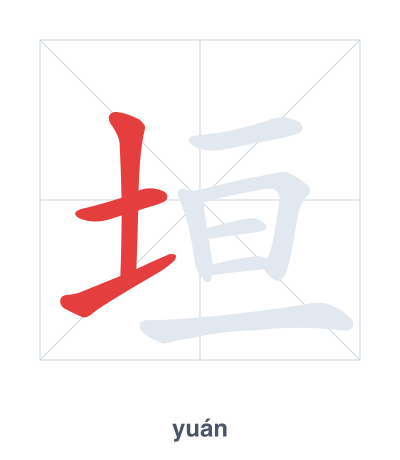
Open Hanzi Writer to see the animated stroke order and practice writing 垣 with real-time feedback.
The character 垣 (yuán) is written with 9 strokes. Follow the standard Chinese stroke order: top to bottom, left to right, outside before inside. The radical 土 is one of its key components.
Practice the correct stroke order with the Hanzi Writer app to see animated stroke-by-stroke guidance with real-time feedback.
垣 means low wall.
垣 combines the radical 土 (earth, the material) with 亘 (a pictograph of the sun crossing the horizon, meaning 'extending across'). Together, they suggest a low wall made of packed earth that stretches across an area, like a boundary or enclosure around a courtyard.
💡 Memory Tip: Picture a low earthen wall (土) stretching across (亘) the ground, barely high enough to lean on.
古老的城垣很壮观。
gǔ lǎo de chéng yuán hěn zhuàng guān
The ancient city walls are magnificent.
这里只有几处断垣。
zhè lǐ zhǐ yǒu jǐ chù duàn yuán
There are only a few broken walls here.
院子的墙垣很高。
yuàn zi de qiáng yuán hěn gāo
The walls of the yard are very high.
Open Hanzi Writer to see the animated stroke order and practice writing 垣 with real-time feedback.
✨ Animated stroke order · Handwriting recognition · HSK-graded practice · Free to use
垣 is composed of the radical 土 (earth, soil) on the left and a phonetic component 亘 (gèn) on the right. The 土 radical indicates the character relates to earth or walls made of earth, while 亘 provides the pronunciation yuán. So the structure shows a low wall built from earth.