腴 (yú) means "fertile or plump" in Chinese. It has 12 strokes with the radical 月.
Rated 4.2/5 in difficulty (advanced).
Appears in 3+ common words including 丰腴 (fēng yú), 肥腴 (féi yú), 膏腴 (gāo yú).
Due to its 12 strokes, Hanzi Writer's error detection shows 腴 requires focused practice — most learners need 10+ attempts for consistent accuracy.
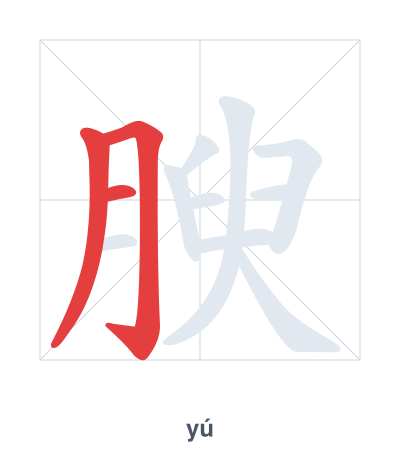
Open Hanzi Writer to see the animated stroke order and practice writing 腴 with real-time feedback.
The character 腴 (yú) is written with 12 strokes. Follow the standard Chinese stroke order: top to bottom, left to right, outside before inside. The radical 月 is one of its key components.
Practice the correct stroke order with the Hanzi Writer app to see animated stroke-by-stroke guidance with real-time feedback.
腴 means fertile or plump.
腴 is a phono-semantic compound with the flesh radical 月 (肉) indicating its connection to meat or body, and 臾 (yú) as a phonetic component. Originally, 臾 depicted a hand grasping a bundle, symbolizing abundance or fullness, which combines with the flesh radical to convey plumpness or fertility.
💡 Memory Tip: Imagine a plump belly (月) so fertile that a hand (the top of 臾) rests on it like a soft cushion.
她的身材很丰腴。
tā de shēn cái hěn fēng yú
Her figure is plump and curvaceous.
这里的鱼肉肥腴。
zhè lǐ de yú ròu féi yú
The fish meat here is rich and fatty.
这是一片膏腴之地。
zhè shì yī piàn gāo yú zhī dì
This is a piece of fertile land.
Open Hanzi Writer to see the animated stroke order and practice writing 腴 with real-time feedback.
✨ Animated stroke order · Handwriting recognition · HSK-graded practice · Free to use
腴 is composed of the radical 月 (meat/flesh) on the left and the phonetic component 臾 (yú) on the right. The 月 radical directly suggests the meaning related to flesh, giving the plump or fertile sense. The right side provides pronunciation while the whole character evokes rich, fleshy land or body.