镛 (yōng) means "large ancient bell" in Chinese. It has 16 strokes with the radical 钅.
Rated 4.2/5 in difficulty (advanced).
Appears in 3+ common words including 镛钟 (yōng zhōng), 大镛 (dà yōng), 镛鼓 (yōng gǔ).
Due to its 16 strokes, Hanzi Writer's error detection shows 镛 requires focused practice — most learners need 10+ attempts for consistent accuracy.
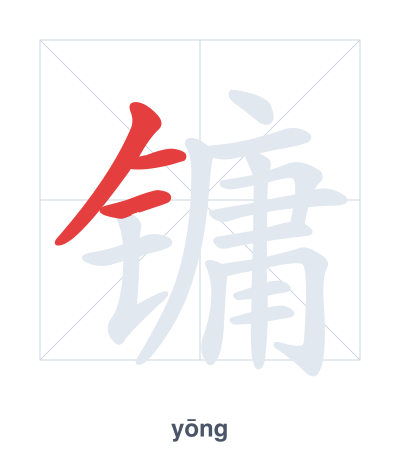
Open Hanzi Writer to see the animated stroke order and practice writing 镛 with real-time feedback.
The character 镛 (yōng) is written with 16 strokes. Follow the standard Chinese stroke order: top to bottom, left to right, outside before inside. The radical 钅 is one of its key components.
Practice the correct stroke order with the Hanzi Writer app to see animated stroke-by-stroke guidance with real-time feedback.
镛 means large ancient bell.
镛 is a phono-semantic compound. The radical 钅 (metal) indicates the bell is made of cast metal, while the right component 庸 (yōng) contributes the pronunciation. The character combines these to mean 'a large ancient bell.'
💡 Memory Tip: Picture a giant metal bell (钅) that hangs in a grand hall (广), and when struck, it makes a deep 'yong' sound (庸) echoing through the building.
古人敲击镛钟。
gǔ rén qiāo jī yōng zhōng
Ancient people struck large bronze bells.
大镛的声音很响亮。
dà yōng de shēng yīn hěn xiǎng liàng
The sound of the large bell is very loud.
镛鼓齐鸣很热闹。
yōng gǔ qí míng hěn rè nào
The bells and drums sound together, making it very lively.
Open Hanzi Writer to see the animated stroke order and practice writing 镛 with real-time feedback.
✨ Animated stroke order · Handwriting recognition · HSK-graded practice · Free to use
镛 is a left-right structure. The left side 钅 (jīn) means metal, and the right side 庸 (yōng) contributes the sound. Since ancient bells were made of metal, the metal radical connects directly to the character's meaning.