臃 (yōng) means "swelling; fat; bloated" in Chinese. It has 17 strokes with the radical 月.
Rated 4.2/5 in difficulty (advanced).
Appears in 3+ common words including 臃肿 (yōng zhǒng), 臃滞 (yōng zhì), 臃肿不堪 (yōng zhǒng bù kān).
Due to its 17 strokes, Hanzi Writer's error detection shows 臃 requires focused practice — most learners need 10+ attempts for consistent accuracy.
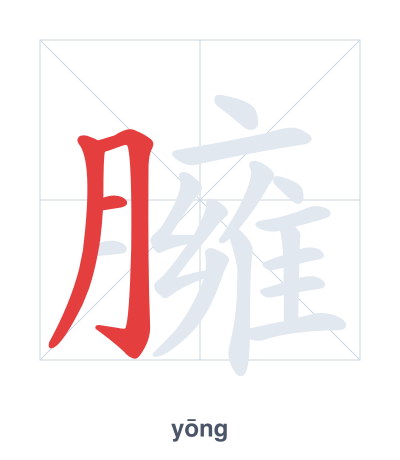
Open Hanzi Writer to see the animated stroke order and practice writing 臃 with real-time feedback.
The character 臃 (yōng) is written with 17 strokes. Follow the standard Chinese stroke order: top to bottom, left to right, outside before inside. The radical 月 is one of its key components.
Practice the correct stroke order with the Hanzi Writer app to see animated stroke-by-stroke guidance with real-time feedback.
臃 means swelling; fat; bloated.
臃 is a phono-semantic compound combining the radical 月 (flesh/body) with 雍 (yōng), which provides the pronunciation. The flesh radical indicates the meaning relates to bodily swelling or bloating, while the phonetic hints at the sound.
💡 Memory Tip: Picture a body (月) so bloated that a bird (隹) gets trapped inside a mouth (口) under a lid (亠), creating a swollen lump.
这件衣服很臃肿。
zhè jiàn yī fú hěn yōng zhǒng
This piece of clothing is very bulky.
机构臃滞影响效率。
jī gòu yōng zhì yǐng xiǎng xiào lǜ
The bloated organization affects efficiency.
他穿得臃肿不堪。
tā chuān dé yōng zhǒng bù kān
He is dressed very bulkily.
Open Hanzi Writer to see the animated stroke order and practice writing 臃 with real-time feedback.
✨ Animated stroke order · Handwriting recognition · HSK-graded practice · Free to use
臃 is composed of the radical 月 (flesh/meat) on the left, indicating the meaning relates to the body, and 雍 on the right, which provides the pronunciation yōng. The right part 雍 originally suggests something crowded or packed, so together the character conveys the idea of swelling or bloating of flesh.