墉 (yōng) means "city wall" in Chinese. It has 14 strokes with the radical 土.
Rated 4.2/5 in difficulty (advanced).
Appears in 3+ common words including 城墉 (chéng yōng), 墉垣 (yōng yuán), 崇墉 (chóng yōng).
Due to its 14 strokes, Hanzi Writer's error detection shows 墉 requires focused practice — most learners need 10+ attempts for consistent accuracy.
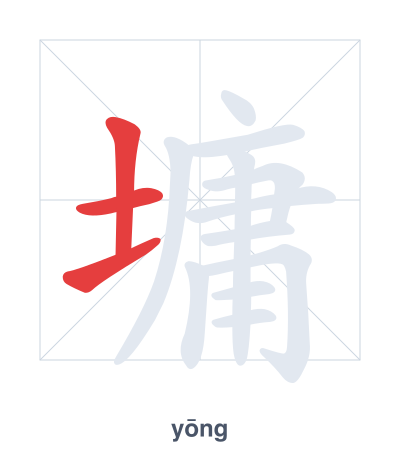
Open Hanzi Writer to see the animated stroke order and practice writing 墉 with real-time feedback.
The character 墉 (yōng) is written with 14 strokes. Follow the standard Chinese stroke order: top to bottom, left to right, outside before inside. The radical 土 is one of its key components.
Practice the correct stroke order with the Hanzi Writer app to see animated stroke-by-stroke guidance with real-time feedback.
墉 means city wall.
墉 is a phono-semantic compound: the radical 土 (earth) indicates it is made of packed earth, and 庸 (yōng, meaning 'to use') provides the sound. In ancient China, city walls were often built from rammed earth, so the 'earth' radical ties directly to the structure's material. The character originally depicted a fortified wall surrounding a city or palace.
💡 Memory Tip: Picture a massive wall of packed earth (土) being built by workers who are all using (庸) their tools in unison—the wall is a "yōng" wall.
城墉非常坚固。
chéng yōng fēi cháng jiān gù
The city wall is very solid.
墉垣已经旧了。
yōng yuán yǐ jīng jiù le
The city walls are already old.
崇墉屹立不倒。
chóng yōng yì lì bù dào
The high wall stands firm and does not fall.
Open Hanzi Writer to see the animated stroke order and practice writing 墉 with real-time feedback.
✨ Animated stroke order · Handwriting recognition · HSK-graded practice · Free to use
墉 is composed of the radical 土 (earth) on the left and the phonetic component 庸 (yōng) on the right. The radical 土 indicates that the character relates to earth or earthen structures, which directly connects to its meaning of 'city wall' (walls were traditionally made of rammed earth). The right side provides the pronunciation clue.