哟 (yō) means "Oh / Hey" in Chinese. It has 9 strokes with the radical 口.
Rated 4/5 in difficulty (challenging).
Appears in 3+ common words including 哎哟 (āi yō), 哟 (yō), 走哟 (zǒu yō).
Due to its 9 strokes, Hanzi Writer's error detection shows 哟 requires focused practice — most learners need 10+ attempts for consistent accuracy.
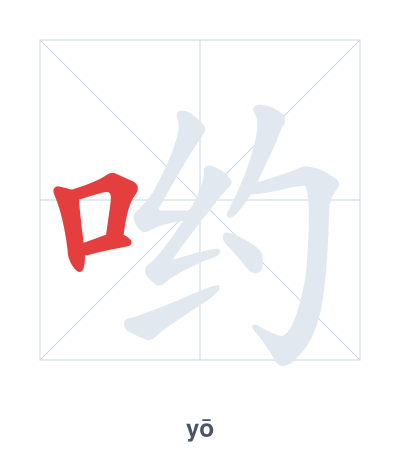
Open Hanzi Writer to see the animated stroke order and practice writing 哟 with real-time feedback.
The character 哟 (yō) is written with 9 strokes. Follow the standard Chinese stroke order: top to bottom, left to right, outside before inside. The radical 口 is one of its key components.
Practice the correct stroke order with the Hanzi Writer app to see animated stroke-by-stroke guidance with real-time feedback.
哟 means Oh / Hey.
哟 is a phono-semantic compound: the mouth radical (口) indicates it is an exclamation or sound, while the phonetic component 约 (yuē) provides an approximation of the pronunciation (yō). Combined, it visually represents a mouth uttering a startled or calling sound like 'oh' or 'hey.'
💡 Memory Tip: Imagine someone opening their mouth (口) and shouting 'Yo!' as they wave a scroll (约) to get your attention.
哎哟,我的脚好疼。
āi yō wǒ de jiǎo hǎo téng
Ouch, my foot hurts.
哟,你今天真漂亮!
yō nǐ jīn tiān zhēn piào liàng
Oh, you look so beautiful today!
大家快点走哟。
dà jiā kuài diǎn zǒu yō
Everyone, walk a bit faster.
Open Hanzi Writer to see the animated stroke order and practice writing 哟 with real-time feedback.
✨ Animated stroke order · Handwriting recognition · HSK-graded practice · Free to use
哟 is made of the radical 口 (mouth) on the left and 约 (yāo/yuē, meaning 'to bind' or 'approximately') on the right. The mouth radical suggests sounds or exclamations, while 约 provides the pronunciation. Together, 哟 represents an exclamation like 'Oh!' or 'Hey!'.