易 (yì) means "Easy / To change" in Chinese. It has 8 strokes with the radical 日, and is HSK Level 3.
Rated 3.7/5 in difficulty (challenging).
Harder than 51% of HSK Level 3 characters.
Appears in 3+ common words including 容易 (róng yì), 贸易 (mào yì), 交易 (jiāo yì).
Due to its 8 strokes, Hanzi Writer's error detection shows 易 requires focused practice — most learners need 10+ attempts for consistent accuracy.
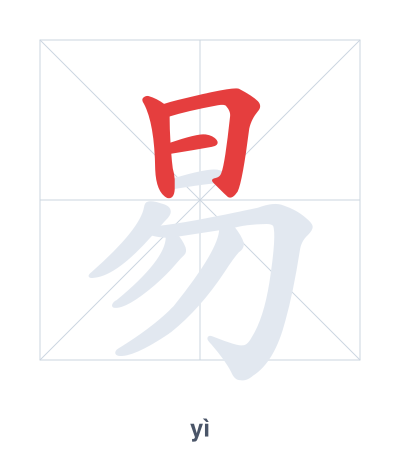
Open Hanzi Writer to see the animated stroke order and practice writing 易 with real-time feedback.
The character 易 (yì) is written with 8 strokes. Follow the standard Chinese stroke order: top to bottom, left to right, outside before inside. The radical 日 is one of its key components.
Practice the correct stroke order with the Hanzi Writer app to see animated stroke-by-stroke guidance with real-time feedback.
易 means Easy / To change.
As an HSK Level 3 character, 易 is an intermediate-level character.
In ancient scripts, 易 was a pictograph of a lizard, an animal known for changing color, which gave rise to the meanings 'change' and 'easy'. Over time, the shape simplified into the modern form with 日 (sun) on top and a stylized tail-like stroke underneath.
💡 Memory Tip: Picture a lizard with a bright sun (日) on its back that changes color effortlessly, showing how easy (易) adaptation can be.
这道题很容易。
zhè dào tí hěn róng yì
This question is very easy.
国际贸易很重要。
guó jì mào yì hěn zhòng yào
International trade is very important.
网上交易很方便。
wǎng shàng jiāo yì hěn fāng biàn
Online transactions are very convenient.
Open Hanzi Writer to see the animated stroke order and practice writing 易 with real-time feedback.
✨ Animated stroke order · Handwriting recognition · HSK-graded practice · Free to use
易 is composed of the radical 日 (sun) on top and 勿 (do not) below. The sun above 'do not' suggests the idea of easy or change, as sunlight can bring warmth that makes things easy or cause transformation. However, the modern meaning is more conventional than directly derived from these parts.