咦 (yí) means "Huh? (expression of surprise)" in Chinese. It has 9 strokes with the radical 口.
Rated 4/5 in difficulty (challenging).
Appears in 2+ common words including 咦 (yí), 咦的一声 (yí de yī shēng).
Due to its 9 strokes, Hanzi Writer's error detection shows 咦 requires focused practice — most learners need 10+ attempts for consistent accuracy.
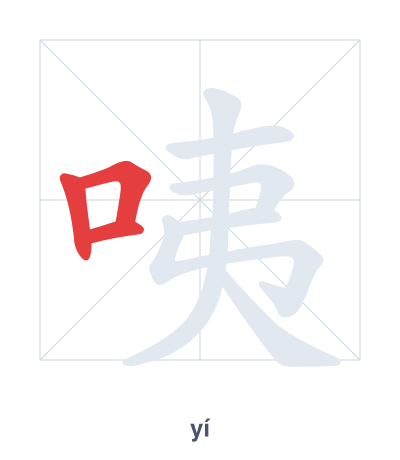
Open Hanzi Writer to see the animated stroke order and practice writing 咦 with real-time feedback.
The character 咦 (yí) is written with 9 strokes. Follow the standard Chinese stroke order: top to bottom, left to right, outside before inside. The radical 口 is one of its key components.
Practice the correct stroke order with the Hanzi Writer app to see animated stroke-by-stroke guidance with real-time feedback.
咦 means Huh? (expression of surprise).
The character 咦 is a compound with the mouth radical (口) indicating sound or speech, and the phonetic component 夷 (yí) contributing pronunciation. It represents an exclamatory sound of surprise, like 'huh?'
💡 Memory Tip: Imagine opening your mouth (口) wide in surprise when you see a strange person (夷, depicted as a big figure with a bow) doing something unexpected.
咦,你怎么在这?
yí nǐ zěn me zài zhè
Huh? Why are you here?
咦,我的钥匙明明放在桌上,怎么不见了?
yí , wǒ de yào shi míng míng fàng zài zhuō shàng , zěn me bú jiàn le ?
Huh? I clearly put my keys on the table, where did they go?
他咦的一声停下了。
tā yí de yī shēng tíng xià le
He stopped with a cry of surprise.
Open Hanzi Writer to see the animated stroke order and practice writing 咦 with real-time feedback.
✨ Animated stroke order · Handwriting recognition · HSK-graded practice · Free to use
The character 咦 is composed of the radical 口 (mouth) on the left, which indicates sound or speech, and the phonetic component 夷 (yí) on the right. The 口 radical suggests that this character is an exclamation made with the mouth. Together they form 咦, which means "Huh?" — a sound of surprise.