猗 (yī) means "Beautiful / Flourishing" in Chinese. It has 11 strokes with the radical 犭.
Rated 4.2/5 in difficulty (advanced).
Appears in 3+ common words including 猗猗 (yī yī), 猗郁 (yī yù), 猗欤 (yī yú).
Due to its 11 strokes, Hanzi Writer's error detection shows 猗 requires focused practice — most learners need 10+ attempts for consistent accuracy.
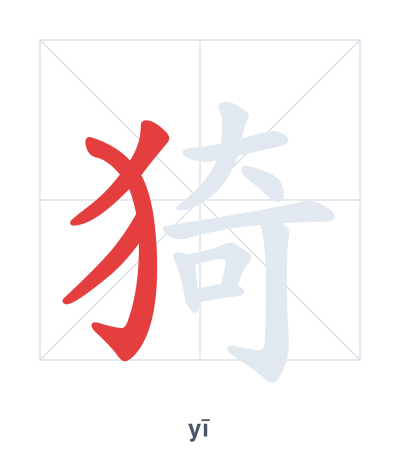
Open Hanzi Writer to see the animated stroke order and practice writing 猗 with real-time feedback.
The character 猗 (yī) is written with 11 strokes. Follow the standard Chinese stroke order: top to bottom, left to right, outside before inside. The radical 犭 is one of its key components.
Practice the correct stroke order with the Hanzi Writer app to see animated stroke-by-stroke guidance with real-time feedback.
猗 means Beautiful / Flourishing.
猗 is a phono-semantic compound: the radical 犭 (dog/animal) suggests a connection to animals, while the right side 奇 (qí, meaning 'strange' or 'odd') provides the pronunciation. The meaning 'beautiful' or 'flourishing' likely derives from the luxurious appearance of an animal's coat, such as a dog with sleek, thriving fur.
💡 Memory Tip: Picture a beautiful, flourishing dog (犭) with a strange (奇) but magnificent mane that makes everyone admire it.
绿竹猗猗,非常好看。
lǜ zhú yī yī fēi cháng hǎo kàn
The green bamboo is lush and very beautiful.
这里的草木长得猗郁。
zhè lǐ de cǎo mù zhǎng dé yī yù
The vegetation here grows luxuriantly.
猗欤盛哉,真是伟大!
yī yú shèng zāi zhēn shì wěi dà
How magnificent and truly great!
Open Hanzi Writer to see the animated stroke order and practice writing 猗 with real-time feedback.
✨ Animated stroke order · Handwriting recognition · HSK-graded practice · Free to use
猗 is made of the radical 犭 (animal) on the left and the phonetic component 奇 (strange/odd) on the right. However, the meaning "beautiful" or "flourishing" does not come directly from these parts; instead, 奇 provides the sound and the character was borrowed for its current use in classical texts.