咿 (yī) means "creak" in Chinese. It has 9 strokes with the radical 口.
Rated 4/5 in difficulty (challenging).
Appears in 3+ common words including 咿呀 (yī yā), 咿咿呀呀 (yī yī yā ya), 咿唔 (yī wú).
Due to its 9 strokes, Hanzi Writer's error detection shows 咿 requires focused practice — most learners need 10+ attempts for consistent accuracy.
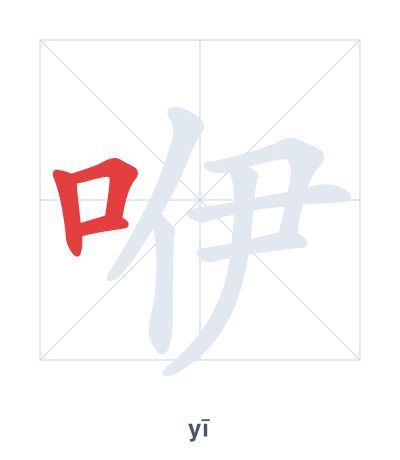
Open Hanzi Writer to see the animated stroke order and practice writing 咿 with real-time feedback.
The character 咿 (yī) is written with 9 strokes. Follow the standard Chinese stroke order: top to bottom, left to right, outside before inside. The radical 口 is one of its key components.
Practice the correct stroke order with the Hanzi Writer app to see animated stroke-by-stroke guidance with real-time feedback.
咿 means creak.
咿 is a phono-semantic compound: the radical 口 (mouth) indicates a sound, and 伊 (yī) provides the pronunciation, together forming an onomatopoeic character for a creaking noise, like a door hinge.
💡 Memory Tip: Imagine a mouth (口) squeaking 'Ee' (伊) as a rusty hinge creaks open.
孩子在咿呀学语。
hái zi zài yī yā xué yǔ
The baby is babbling.
木门咿咿呀呀地响。
mù mén yī yī yā ya dì xiǎng
The wooden door creaked.
教室里传出咿唔声。
jiào shì lǐ chuán chū yī wú shēng
The sound of reading aloud came from the classroom.
Open Hanzi Writer to see the animated stroke order and practice writing 咿 with real-time feedback.
✨ Animated stroke order · Handwriting recognition · HSK-graded practice · Free to use
咿 combines the radical 口 (mouth) on the left with 伊 (yī, a pronoun or phonetic component) on the right. The mouth radical suggests sounds or speech, and the phonetic part 伊 gives the pronunciation clue. Together, 咿 mimics the creaking or babbling noise made by the mouth.