唔 (wú) means "Hmm (or 'not' in Cantonese)." in Chinese. It has 10 strokes with the radical 口.
Rated 4.2/5 in difficulty (advanced).
Appears in 3+ common words including 唔 (wú), 唔唔 (wú wú), 唔好 (wú hǎo).
Due to its 10 strokes, Hanzi Writer's error detection shows 唔 requires focused practice — most learners need 10+ attempts for consistent accuracy.
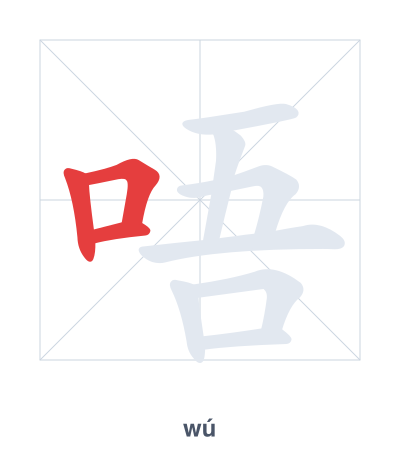
Open Hanzi Writer to see the animated stroke order and practice writing 唔 with real-time feedback.
The character 唔 (wú) is written with 10 strokes. Follow the standard Chinese stroke order: top to bottom, left to right, outside before inside. The radical 口 is one of its key components.
Practice the correct stroke order with the Hanzi Writer app to see animated stroke-by-stroke guidance with real-time feedback.
唔 means Hmm (or 'not' in Cantonese)..
唔 combines the mouth radical (口) with 吾 (wú), which provides the sound. The mouth indicates an utterance or interjection, hence its use as 'hmm' in Mandarin or the negation particle in Cantonese.
💡 Memory Tip: Picture a mouth (口) forming a puzzled 'wu' sound (吾) as you scratch your head and go 'Hmm?'
唔,我知道了。
wú wǒ zhī dào le
Hmm, I see.
他唔唔地答应了。
tā wú wú dì dā yìng le
He mumbled his agreement.
唔好意思,我迟到了。
wú hǎo yì si wǒ chí dào le
Sorry, I'm late.
Open Hanzi Writer to see the animated stroke order and practice writing 唔 with real-time feedback.
✨ Animated stroke order · Handwriting recognition · HSK-graded practice · Free to use
唔 is composed of the radical 口 (mouth) on the left and 吾 (wú, an ancient word for 'I' or 'my') on the right. The 口 suggests sounds made by the mouth, and 吾 provides the pronunciation, making it a phonetic compound that represents thinking sounds like 'hmm'.