Hanzi Writer

How to Write 嘢 (yě) — Meaning “(Cantonese) Thing / Stuff”

14 strokes Radical: 口

嘢 (yě) means "(Cantonese) Thing / Stuff" in Chinese. It has 14 strokes with the radical 口.

Rated 4.2/5 in difficulty (advanced).

Appears in 3+ common words including 乜嘢 (miē yě), 嘢食 (yě shí), 讲嘢 (jiǎng yě).

Due to its 14 strokes, Hanzi Writer's error detection shows 嘢 requires focused practice — most learners need 10+ attempts for consistent accuracy.
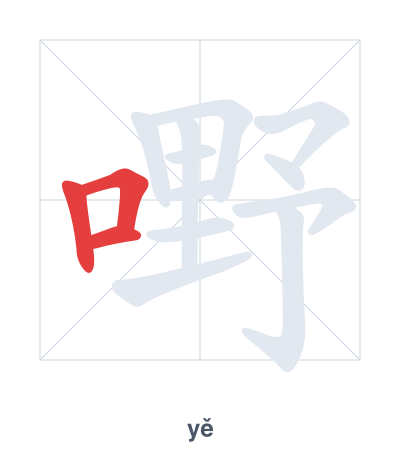
Stroke order practice for 嘢 - yě

Practice Writing 嘢 (yě)

Open Hanzi Writer to see the animated stroke order and practice writing 嘢 with real-time feedback.

The character (yě) is written with 14 strokes. Follow the standard Chinese stroke order: top to bottom, left to right, outside before inside. The radical is one of its key components.

Practice the correct stroke order with the Hanzi Writer app to see animated stroke-by-stroke guidance with real-time feedback.

means (Cantonese) Thing / Stuff.

Character
Pinyinyě (ye)
Meaning(Cantonese) Thing / Stuff
Strokes14
Radical
Difficulty4.2/5

嘢 combines the mouth radical (口) indicating speech or sound, with the phonetic component 耶 (yē) which provides pronunciation. This character is unique to Cantonese, where it functions as a colloquial word for 'thing' or 'stuff,' reflecting its usage in spoken language.

💡 Memory Tip: Picture a mouth (口) saying 'Yeah!' (耶) while pointing at a pile of random 'stuff' you just found.

miē yě
what (Cantonese)
yě shí
food; something to eat
jiǎng yě
To talk / To speak (Cantonese)

你在看乜嘢?

nǐ zài kàn miē yě

What are you looking at?

这里有很多嘢食。

zhè lǐ yǒu hěn duō yě shí

There is a lot of food here.

唔好讲嘢。

wú hǎo jiǎng yě

Don't talk.

Character Pinyin Strokes Radical
(current) 14
14
chì 12
12
Stroke order practice for 嘢 - yě

Practice Writing 嘢 (yě)

Open Hanzi Writer to see the animated stroke order and practice writing 嘢 with real-time feedback.

✨ Animated stroke order · Handwriting recognition · HSK-graded practice · Free to use

Frequently Asked Questions about 嘢

嘢 is composed of the radical 口 (mouth) on the left, and the phonetic component 野 (yě, field/wild) on the right. The mouth radical suggests spoken language, which fits because 嘢 is a Cantonese colloquial character often used in speech. The right side provides pronunciation and can hint at 'something out in the wild' or 'stuff'.

Characters with Radical 口

Other 14-Stroke Characters