掖 (yē/yè) means "to tuck in" in Chinese. It has 11 strokes with the radical 扌.
Rated 4.2/5 in difficulty (advanced).
Appears in 3+ common words including 掖好 (yē hǎo), 藏掖 (cáng yè), 扶掖 (fú yè).
Due to its 11 strokes, Hanzi Writer's error detection shows 掖 requires focused practice — most learners need 10+ attempts for consistent accuracy.
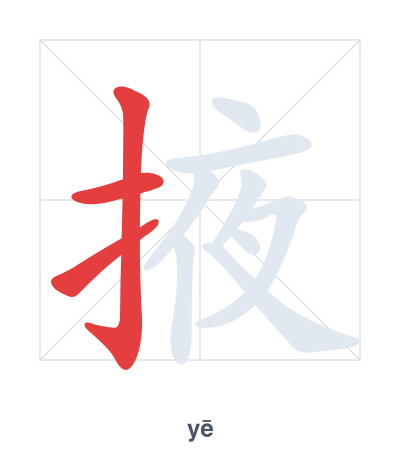
Open Hanzi Writer to see the animated stroke order and practice writing 掖 with real-time feedback.
The character 掖 (yē/yè) is written with 11 strokes. Follow the standard Chinese stroke order: top to bottom, left to right, outside before inside. The radical 扌 is one of its key components.
Practice the correct stroke order with the Hanzi Writer app to see animated stroke-by-stroke guidance with real-time feedback.
掖 means to tuck in.
This is a polyphonic character with readings: yē, yè.
This compound character combines the hand radical 扌, indicating an action, with 夜 (night), which provides the sound. Originally it meant to support under the arm or to tuck something in, as if hiding it away for the night.
💡 Memory Tip: Imagine a hand (扌) tucking you into bed at night (夜) — that's tucking in.
把衣服掖好。
bǎ yī fú yē hǎo
Tuck in your clothes.
他把东西藏掖起来。
tā bǎ dōng xī zàng yē qǐ lái
He hid the things away.
老师扶掖后辈。
lǎo shī fú yè hòu bèi
The teacher supports and guides the younger generation.
Open Hanzi Writer to see the animated stroke order and practice writing 掖 with real-time feedback.
✨ Animated stroke order · Handwriting recognition · HSK-graded practice · Free to use
掖 is composed of the hand radical 扌 on the left and the phonetic component 夜 (meaning night) on the right. The hand radical suggests an action done with the hand, and the meaning "to tuck in" is a hand motion often associated with bedtime, linking to the night component.