嫣 (yān) means "beautiful; radiant" in Chinese. It has 14 strokes with the radical 女.
Rated 4.2/5 in difficulty (advanced).
Appears in 3+ common words including 嫣然 (yān rán), 嫣红 (yān hóng), 嫣笑 (yān xiào).
Due to its 14 strokes, Hanzi Writer's error detection shows 嫣 requires focused practice — most learners need 10+ attempts for consistent accuracy.
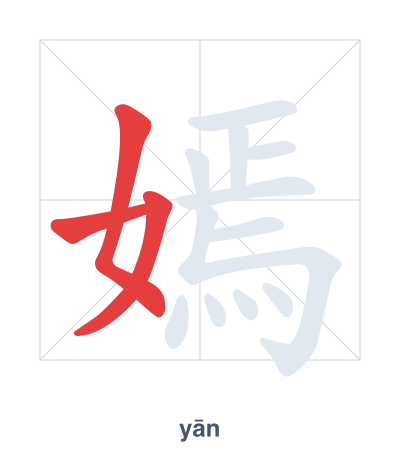
Open Hanzi Writer to see the animated stroke order and practice writing 嫣 with real-time feedback.
The character 嫣 (yān) is written with 14 strokes. Follow the standard Chinese stroke order: top to bottom, left to right, outside before inside. The radical 女 is one of its key components.
Practice the correct stroke order with the Hanzi Writer app to see animated stroke-by-stroke guidance with real-time feedback.
嫣 means beautiful; radiant.
嫣 is a phono-semantic compound, with 女 (woman) as the semantic radical indicating beauty related to women, and 焉 (yān) as the phonetic component. The character originally described a woman's radiant, beautiful smile or appearance.
💡 Memory Tip: Picture a woman (女) with such a radiant smile that even a soaring bird (焉) pauses to admire her beauty.
她嫣然一笑很动人。
tā yān rán yí xiào hěn dòng rén
Her sweet smile is very moving.
花园里百花嫣红。
huā yuán lǐ bǎi huā yān hóng
The garden is filled with bright red flowers.
她的嫣笑很有感染力。
tā de yān xiào hěn yǒu gǎn rǎn lì
Her sweet smile is very infectious.
Open Hanzi Writer to see the animated stroke order and practice writing 嫣 with real-time feedback.
✨ Animated stroke order · Handwriting recognition · HSK-graded practice · Free to use
嫣 is composed of the radical 女 (woman) on the left and the phonetic component 焉 on the right. The 女 radical indicates that the character relates to femininity or women, while 焉 provides the pronunciation yān. Together they create the meaning of 'beautiful' or 'radiant,' especially describing a woman's smile.