垭 (yā) means "mountain pass" in Chinese. It has 9 strokes with the radical 土.
Rated 4/5 in difficulty (challenging).
Appears in 3+ common words including 垭口 (yā kǒu), 山垭 (shān yā), 垭子 (yā zi).
Due to its 9 strokes, Hanzi Writer's error detection shows 垭 requires focused practice — most learners need 10+ attempts for consistent accuracy.
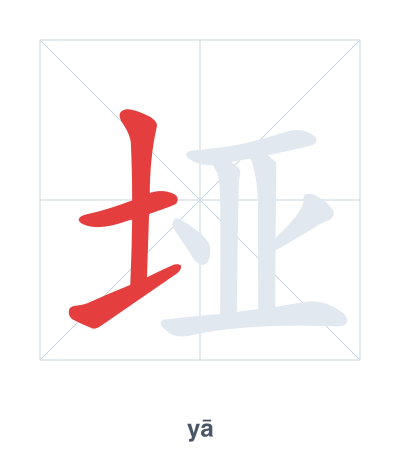
Open Hanzi Writer to see the animated stroke order and practice writing 垭 with real-time feedback.
The character 垭 (yā) is written with 9 strokes. Follow the standard Chinese stroke order: top to bottom, left to right, outside before inside. The radical 土 is one of its key components.
Practice the correct stroke order with the Hanzi Writer app to see animated stroke-by-stroke guidance with real-time feedback.
垭 means mountain pass.
垭 is a phono-semantic compound: the radical 土 (earth/mountain) indicates the terrain, while 亚 (yà, meaning 'second' or 'inferior') provides the sound and also suggests a low or narrow gap between mountains, like a secondary passage.
💡 Memory Tip: Imagine a mountain pass shaped like the character 亚 (a notch or dip) with earth (土) piled on either side, forming a narrow gap you must squeeze through.
我们走过了山垭口。
wǒ men zǒu guò le shān yā kǒu
We passed through the mountain pass.
山垭那边的风景美。
shān yā nà biān de fēng jǐng měi
The scenery on the other side of the mountain pass is beautiful.
翻过这个垭子就到了。
fān guò zhè ge yā zi jiù dào le
You will arrive once you cross this mountain pass.
Open Hanzi Writer to see the animated stroke order and practice writing 垭 with real-time feedback.
✨ Animated stroke order · Handwriting recognition · HSK-graded practice · Free to use
垭 is made of two parts: the radical 土 (earth) on the left, and 亚 (yà, meaning "second" or "Asia") on the right. The 土 radical hints that the character is about a land or earth feature, like a mountain pass. The 亚 component provides the pronunciation yā and gives a sense of "secondary" or "saddle-like" shape, which fits a mountain pass.