汛 (xùn) means "flood / high water" in Chinese. It has 6 strokes with the radical 氵, and is HSK Level 7.
Rated 3.2/5 in difficulty (challenging).
Harder than 11% of HSK Level 7 characters.
Appears in 3+ common words including 汛期 (xùn qī), 防汛 (fáng xùn), 汛情 (xùn qíng).
Due to its 6 strokes, Hanzi Writer's error detection shows 汛 requires focused practice — most learners need 10+ attempts for consistent accuracy.
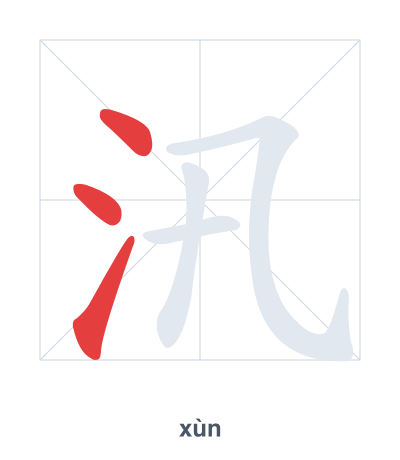
Open Hanzi Writer to see the animated stroke order and practice writing 汛 with real-time feedback.
The character 汛 (xùn) is written with 6 strokes. Follow the standard Chinese stroke order: top to bottom, left to right, outside before inside. The radical 氵 is one of its key components.
Practice the correct stroke order with the Hanzi Writer app to see animated stroke-by-stroke guidance with real-time feedback.
汛 means flood / high water.
As an HSK Level 7 character, 汛 is an intermediate-level character.
汛 is a compound character with the radical 氵 (water) and the phonetic component 卂 (xùn, meaning 'swift' or 'rapid'). The combination suggests water that rises or flows swiftly, as in a seasonal flood or high water.
💡 Memory Tip: Imagine water (氵) rushing swiftly (卂) like a sudden flood sweeping everything away.
现在是汛期。
xiàn zài shì xùn qī
It is now the flood season.
大家要做好防汛。
dà jiā yào zuò hǎo fáng xùn
Everyone should prepare for flood control.
汛情很严重。
xùn qíng hěn yán zhòng
The flood situation is very serious.
Open Hanzi Writer to see the animated stroke order and practice writing 汛 with real-time feedback.
✨ Animated stroke order · Handwriting recognition · HSK-graded practice · Free to use
The character 汛 is composed of the radical 氵 (water) on the left and the phonetic component 卂 (xùn, meaning "swift") on the right. Water (氵) directly relates to flooding, while the right side suggests the rapid rising of water, together conveying the idea of a swift flood or high water.