朽 (xiǔ) means "rotten; decayed" in Chinese. It has 6 strokes with the radical 木, and is HSK Level 7.
Rated 3.2/5 in difficulty (challenging).
Harder than 11% of HSK Level 7 characters.
Appears in 3+ common words including 腐朽 (fǔ xiǔ), 朽木 (xiǔ mù), 不朽 (bù xiǔ).
Due to its 6 strokes, Hanzi Writer's error detection shows 朽 requires focused practice — most learners need 10+ attempts for consistent accuracy.
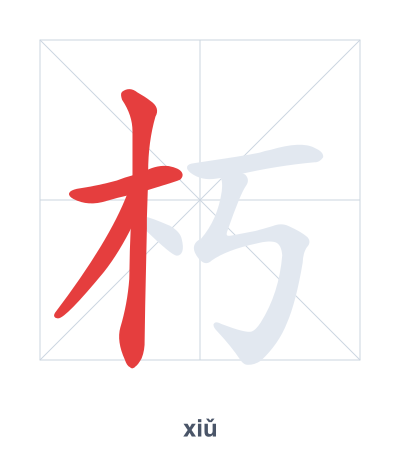
Open Hanzi Writer to see the animated stroke order and practice writing 朽 with real-time feedback.
The character 朽 (xiǔ) is written with 6 strokes. Follow the standard Chinese stroke order: top to bottom, left to right, outside before inside. The radical 木 is one of its key components.
Practice the correct stroke order with the Hanzi Writer app to see animated stroke-by-stroke guidance with real-time feedback.
朽 means rotten; decayed.
As an HSK Level 7 character, 朽 is an intermediate-level character.
朽 combines the radical 木 (tree) with 丂, an ancient component that originally depicted a bent, decayed branch or a breath of air symbolizing decomposition. Together, they show wood that has become weak, rotten, and falling apart.
💡 Memory Tip: Picture a tree (木) with a crooked, broken branch (丂) that crumbles into dust when you touch it—completely rotten.
这块木头腐朽了。
zhè kuài mù tou fǔ xiǔ le
This piece of wood has rotted.
朽木很容易断。
xiǔ mù hěn róng yì duàn
Rotten wood breaks easily.
他的精神永垂不朽。
tā de jīng shén yǒng chuí bù xiǔ
His spirit will live forever.
Open Hanzi Writer to see the animated stroke order and practice writing 朽 with real-time feedback.
✨ Animated stroke order · Handwriting recognition · HSK-graded practice · Free to use
朽 combines the radical 木 (wood/tree) on the left and 丂 (an ancient component suggesting decay) on the right. The wood radical shows it relates to trees or wood, and the right part hints at the process of rotting, giving the character its meaning of "rotten" or "decayed."