咻 (xiū) means "whiz" in Chinese. It has 9 strokes with the radical 口.
Rated 4/5 in difficulty (challenging).
Appears in 3+ common words including 咻咻 (xiū xiū), 咻的一声 (xiū de yī shēng), 咻咻声 (xiū xiū shēng).
Due to its 9 strokes, Hanzi Writer's error detection shows 咻 requires focused practice — most learners need 10+ attempts for consistent accuracy.
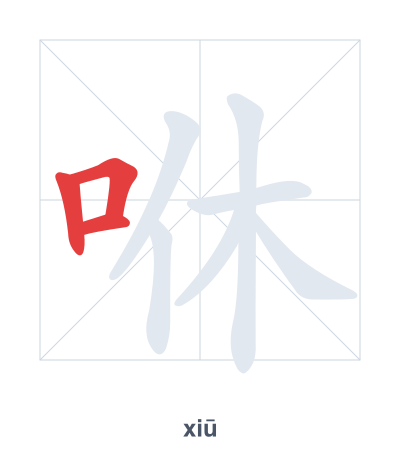
Open Hanzi Writer to see the animated stroke order and practice writing 咻 with real-time feedback.
The character 咻 (xiū) is written with 9 strokes. Follow the standard Chinese stroke order: top to bottom, left to right, outside before inside. The radical 口 is one of its key components.
Practice the correct stroke order with the Hanzi Writer app to see animated stroke-by-stroke guidance with real-time feedback.
咻 means whiz.
咻 is a phono-semantic compound: the radical 口 (mouth) indicates that the character represents a sound, while 休 (xiū, meaning 'rest') provides the pronunciation. It depicts the whizzing or panting sound made by something moving swiftly, like an arrow or heavy breathing.
💡 Memory Tip: Picture a person (休) resting against a tree when a speeding arrow whizzes past, making a sharp 'xiu' sound from their surprised mouth (口).
他咻咻地喘着气。
tā xiū xiū dì chuǎn zhe qì
He was panting heavily.
箭咻的一声飞过去。
jiàn xiū de yī shēng fēi guò qù
The arrow flew past with a whizzing sound.
这种声音叫咻咻声。
zhè zhǒng shēng yīn jiào xiū xiū shēng
This sound is called a whistling or wheezing sound.
Open Hanzi Writer to see the animated stroke order and practice writing 咻 with real-time feedback.
✨ Animated stroke order · Handwriting recognition · HSK-graded practice · Free to use
咻 is composed of the radical 口 (mouth) on the left and the phonetic component 休 (xiū, meaning "rest") on the right. The mouth radical suggests a sound, while 休 provides the pronunciation and a hint of the "whizzing" noise made when something swiftly passes by. Together, they form an onomatopoeic character for a sharp, whistling sound like a speeding arrow or wind.