薤 (xiè) means "Chinese onion" in Chinese. It has 16 strokes with the radical 艹.
Rated 4.2/5 in difficulty (advanced).
Appears in 3+ common words including 薤白 (xiè bái), 薤菜 (xiè cài), 薤露 (xiè lù).
Due to its 16 strokes, Hanzi Writer's error detection shows 薤 requires focused practice — most learners need 10+ attempts for consistent accuracy.
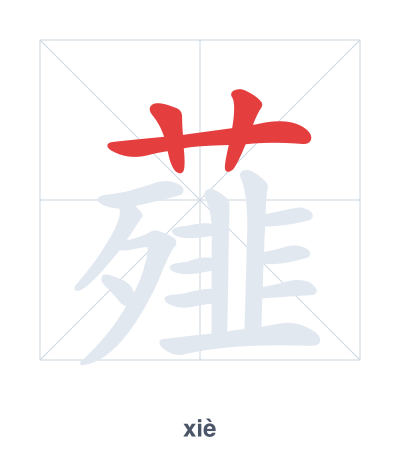
Open Hanzi Writer to see the animated stroke order and practice writing 薤 with real-time feedback.
The character 薤 (xiè) is written with 16 strokes. Follow the standard Chinese stroke order: top to bottom, left to right, outside before inside. The radical 艹 is one of its key components.
Practice the correct stroke order with the Hanzi Writer app to see animated stroke-by-stroke guidance with real-time feedback.
薤 means Chinese onion.
薤 combines the radical 艹 (grass) with 㕚 (claw/hand), suggesting the plant's bulbous root that resembles a claw or the way it is pulled from the ground.
💡 Memory Tip: Picture grass (艹) sprouting from a claw-like hand (㕚) that clutches a white onion bulb underground.
薤白是一种中药。
xiè bái shì yī zhǒng zhōng yào
Xiebai is a type of traditional Chinese medicine.
薤菜吃起来很香。
xiè cài chī qǐ lái hěn xiāng
Chinese onions taste very fragrant.
薤露是一首古诗。
xiè lù shì yī shǒu gǔ shī
'Xie Lu' is an ancient poem.
Open Hanzi Writer to see the animated stroke order and practice writing 薤 with real-time feedback.
✨ Animated stroke order · Handwriting recognition · HSK-graded practice · Free to use
薤 has the grass radical 艹 on top, which indicates it is a plant. Below is 韭 (jiǔ, leek) and then 歹 (dǎi, bad/evil), but actually 薤 is a type of onion, so 韭 (leek) hints at the plant family, and the whole character combines to represent a specific onion-like vegetable.