咥 (xì) means "to eat (dialect); to laugh" in Chinese. It has 9 strokes with the radical 口.
Rated 4/5 in difficulty (challenging).
Appears in 3+ common words including 咥饭 (xì fàn), 咥笑 (xì xiào), 咥一口 (xì yī kǒu).
Due to its 9 strokes, Hanzi Writer's error detection shows 咥 requires focused practice — most learners need 10+ attempts for consistent accuracy.
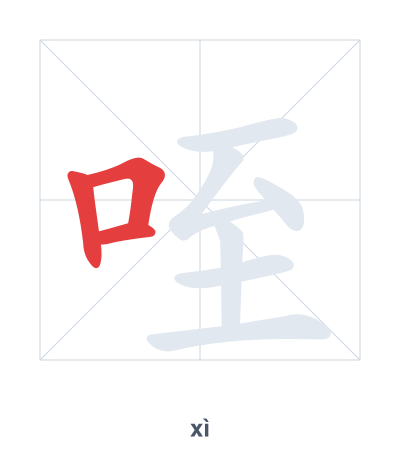
Open Hanzi Writer to see the animated stroke order and practice writing 咥 with real-time feedback.
The character 咥 (xì) is written with 9 strokes. Follow the standard Chinese stroke order: top to bottom, left to right, outside before inside. The radical 口 is one of its key components.
Practice the correct stroke order with the Hanzi Writer app to see animated stroke-by-stroke guidance with real-time feedback.
咥 means to eat (dialect); to laugh.
咥 is a phono-semantic compound combining the mouth radical 口 (indicating an action of the mouth, such as eating or laughing) with 至 (zhì, meaning 'arrive'), which provides the pronunciation clue. Historically, the character appears in the Book of Songs (诗经) to describe hearty laughter, while in some dialects it is used for eating.
💡 Memory Tip: Picture a mouth (口) laughing so hard that a slice of pizza (至, resembling a pizza slice arriving) falls out, and you have to eat it off the ground—咥!.
我们去咥饭吧。
wǒ men qù xì fàn ba
Let's go grab a big meal.
兄弟二人咥笑。
xiōng dì èr rén xì xiào
The two brothers laughed loudly.
狠狠地咥一口肉。
hěn hěn dì xì yī kǒu ròu
To take a big, hearty bite of meat.
Open Hanzi Writer to see the animated stroke order and practice writing 咥 with real-time feedback.
✨ Animated stroke order · Handwriting recognition · HSK-graded practice · Free to use
咥 is made of the radical 口 (mouth) and the component 至 (to reach or arrive). The mouth reaching food suggests eating, and a wide-open mouth can also imply laughing. Together, these parts explain 咥's meanings of 'to eat' (in dialect) and 'to laugh'.