樨 (xī) means "osmanthus" in Chinese. It has 16 strokes with the radical 木.
Rated 4.2/5 in difficulty (advanced).
Appears in 3+ common words including 木樨 (mù xī), 木樨肉 (mù xī ròu), 丹樨 (dān xī).
Due to its 16 strokes, Hanzi Writer's error detection shows 樨 requires focused practice — most learners need 10+ attempts for consistent accuracy.
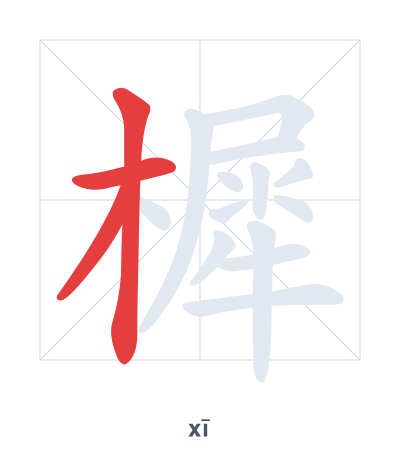
Open Hanzi Writer to see the animated stroke order and practice writing 樨 with real-time feedback.
The character 樨 (xī) is written with 16 strokes. Follow the standard Chinese stroke order: top to bottom, left to right, outside before inside. The radical 木 is one of its key components.
Practice the correct stroke order with the Hanzi Writer app to see animated stroke-by-stroke guidance with real-time feedback.
樨 means osmanthus.
樨 is a phono-semantic compound: the radical 木 (tree) indicates it's a type of tree, while 犀 (xī, rhinoceros) gives the pronunciation. The character refers to the fragrant osmanthus tree, whose small yellow flowers are highly aromatic.
💡 Memory Tip: Imagine a rhinoceros (犀) climbing a tree (木) to sniff the sweet-smelling osmanthus flowers.
木樨就是桂花。
mù xī jiù shì guì huā
Muxi is just another name for sweet osmanthus.
我喜欢吃木樨肉。
wǒ xǐ huān chī mù xī ròu
I like eating Moo Shu Pork.
丹樨上铺了地毯。
dān xī shàng pù le dì tǎn
A carpet was laid on the red steps.
Open Hanzi Writer to see the animated stroke order and practice writing 樨 with real-time feedback.
✨ Animated stroke order · Handwriting recognition · HSK-graded practice · Free to use
The character 樨 is formed by the radical 木 (wood/tree) on the left, showing it is related to trees or plants. The right part 犀 (rhinoceros) provides the pronunciation xī and does not directly contribute to the meaning, but together they represent the osmanthus tree.