鹜 (wù) means "wild duck" in Chinese. It has 14 strokes with the radical 鸟.
Rated 4.2/5 in difficulty (advanced).
Appears in 3+ common words including 野鹜 (yě wù), 鹜鸟 (wù niǎo), 趋之若鹜 (qū zhī ruò wù).
Due to its 14 strokes, Hanzi Writer's error detection shows 鹜 requires focused practice — most learners need 10+ attempts for consistent accuracy.
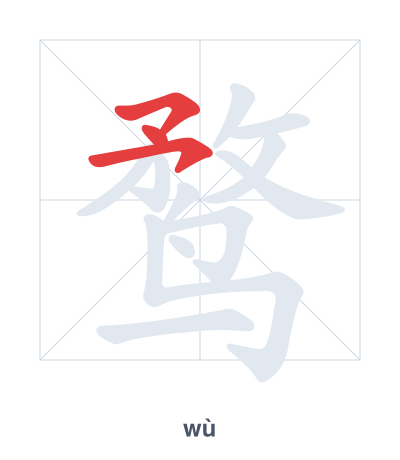
Open Hanzi Writer to see the animated stroke order and practice writing 鹜 with real-time feedback.
The character 鹜 (wù) is written with 14 strokes. Follow the standard Chinese stroke order: top to bottom, left to right, outside before inside. The radical 鸟 is one of its key components.
Practice the correct stroke order with the Hanzi Writer app to see animated stroke-by-stroke guidance with real-time feedback.
鹜 means wild duck.
鹜 is a phono-semantic compound: the radical 鸟 (bird) indicates it is a type of bird, while the component 敄 (pronounced wù) provides the sound. Although 敄 originally meant 'to strive' or 'to exert', here it serves mainly as a phonetic hint, not directly related to the meaning 'wild duck'.
💡 Memory Tip: Imagine a wild duck (鸟) fleeing as a hunter thrusts a spear (矛) with his hand (攵) — that startled duck is the 鹜.
湖边有很多野鹜。
hú biān yǒu hěn duō yě wù
There are many wild ducks by the lake.
鹜鸟在水里游。
wù niǎo zài shuǐ lǐ yóu
Wild ducks swim in the water.
大家对他趋之若鹜。
dà jiā duì tā qū zhī ruò wù
Everyone is flocking to him.
Open Hanzi Writer to see the animated stroke order and practice writing 鹜 with real-time feedback.
✨ Animated stroke order · Handwriting recognition · HSK-graded practice · Free to use
鹜 is made of two parts: the top part 敄 (wù, meaning 'to exert effort') and the bottom part 鸟 (niǎo, 'bird'). Together, they suggest a bird that works hard or moves quickly, fitting the meaning 'wild duck' known for its swift flight.