隈 (wēi) means "Cove / Bend in a river or mountain" in Chinese. It has 11 strokes with the radical 阝.
Rated 3.9/5 in difficulty (challenging).
Appears in 3+ common words including 山隈 (shān wēi), 墙隈 (qiáng wēi), 隈处 (wēi chù).
Due to its 11 strokes, Hanzi Writer's error detection shows 隈 requires focused practice — most learners need 10+ attempts for consistent accuracy.
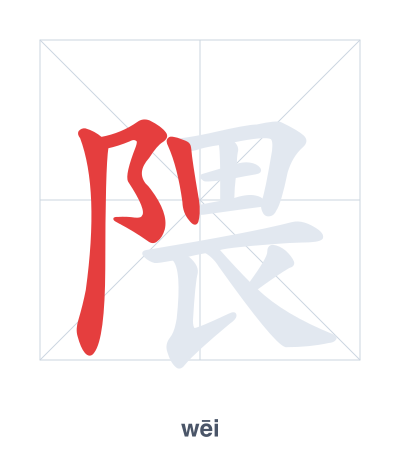
Open Hanzi Writer to see the animated stroke order and practice writing 隈 with real-time feedback.
The character 隈 (wēi) is written with 11 strokes. Follow the standard Chinese stroke order: top to bottom, left to right, outside before inside. The radical 阝 is one of its key components.
Practice the correct stroke order with the Hanzi Writer app to see animated stroke-by-stroke guidance with real-time feedback.
隈 means Cove / Bend in a river or mountain.
隈 combines the radical 阝 (a variant of 阜, meaning 'mound' or 'hill') on the left with the phonetic component 畏 (wèi, 'fear' or 'awe'). The left part indicates a landform feature, while the right suggests the sound; together they denote a concave bend or nook in a hill or riverbank—a place where terrain curves inward, as if hiding something awe-inspiring.
💡 Memory Tip: Picture a frightened person (畏) huddled inside a curved hollow of a hill (阝)—that's the hidden cove or bend called 隈.
山隈里有一间小屋。
shān wēi lǐ yǒu yī jiān xiǎo wū
There is a small hut in the mountain recess.
墙隈长了一些小草。
qiáng wēi zhǎng le yī xiē xiǎo cǎo
Some small grass grew in the corner of the wall.
他躲在隈处避风。
tā duǒ zài wēi chù bì fēng
He hid in a sheltered spot to escape the wind.
Open Hanzi Writer to see the animated stroke order and practice writing 隈 with real-time feedback.
✨ Animated stroke order · Handwriting recognition · HSK-graded practice · Free to use
The character 隈 is composed of the radical 阝 (meaning hill or mound) on the left and the phonetic component 畏 (wèi) on the right. The left part indicates a geographical feature, while the right part provides the sound and also hints at a hidden, inward-curving shape, giving the meaning of a cove or bend in a mountain or river.