Hanzi Writer

How to Write 亢 (kàng) — Meaning “high; excessive; arrogant”

kàng 4 strokes Radical: 亠

亢 (kàng) means "high; excessive; arrogant" in Chinese. It has 4 strokes with the radical 亠.

Rated 2.4/5 in difficulty (moderate).

Appears in 3+ common words including 亢奋 (kàng fèn), 高亢 (gāo kàng), 不卑不亢 (bù bēi bù kàng).

Hanzi Writer's stroke validation shows learners typically need 5-8 attempts to write 亢 with correct proportion and order.
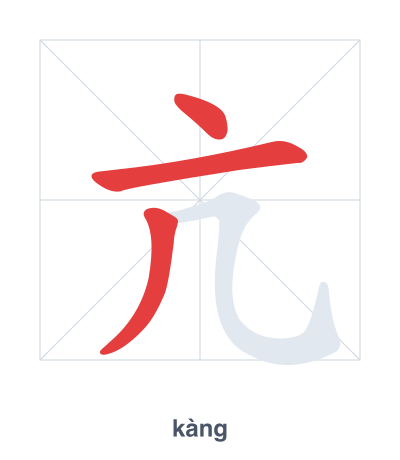
Stroke order practice for 亢 - kàng

Practice Writing 亢 (kàng)

Open Hanzi Writer to see the animated stroke order and practice writing 亢 with real-time feedback.

The character (kàng) is written with 4 strokes. Follow the standard Chinese stroke order: top to bottom, left to right, outside before inside. The radical is one of its key components.

Practice the correct stroke order with the Hanzi Writer app to see animated stroke-by-stroke guidance with real-time feedback.

means high; excessive; arrogant.

Character
Pinyinkàng (kang)
Meaninghigh; excessive; arrogant
Strokes4
Radical
Difficulty2.4/5

The character 亢 originally depicted a person with a mark on the neck (古文字 shows a man with a line across the neck), from which came the meaning 'neck' (now written 吭). This sense extended to 'high' or 'excessive'—the neck is a high and prominent part of the body, and an arrogant person holds their head high. Structurally, the top component 亠 (a lid or head) and the lower 几 (like legs) together suggest a figure standing tall with an elevated, proud posture.

💡 Memory Tip: Imagine a person with a big head (亠) and legs spread apart (几) strutting around—so arrogant and excessive that they're 'high' on themselves.

kàng fèn
excited; stimulated
gāo kàng
resonant; high-pitched
bù bēi bù kàng
neither servile nor overbearing; showing self-respect

听完音乐他很亢奋。

tīng wán yīn yuè tā hěn kàng fèn

He was very excited after listening to the music.

她的歌声非常高亢。

tā de gē shēng fēi cháng gāo kàng

Her singing voice is very high-pitched and resonant.

他的态度不卑不亢。

tā de tài dù bù bēi bù kàng

His attitude is neither servile nor overbearing.

Character Pinyin Strokes Radical
(current) kàng 4
wáng 3
jiāo 6
hài 6
Stroke order practice for 亢 - kàng

Practice Writing 亢 (kàng)

Open Hanzi Writer to see the animated stroke order and practice writing 亢 with real-time feedback.

✨ Animated stroke order · Handwriting recognition · HSK-graded practice · Free to use

Frequently Asked Questions about 亢

The character 亢 consists of the radical 亠 (lid or top) on top and the character 几 (table or small stool) below. The top part suggests something elevated, while the whole shape implies being high up, which connects to the meanings 'high' and 'excessive'.

Characters with Radical 亠

Other 4-Stroke Characters