凸 (tū) means "Convex; protruding" in Chinese. It has 5 strokes with the radical 凵, and is HSK Level 7.
Rated 2.7/5 in difficulty (moderate).
Harder than 3% of HSK Level 7 characters.
Appears in 3+ common words including 凸出 (tū chū), 凸透镜 (tū tòu jìng), 凸起 (tū qǐ).
Hanzi Writer's stroke validation shows learners typically need 5-8 attempts to write 凸 with correct proportion and order.
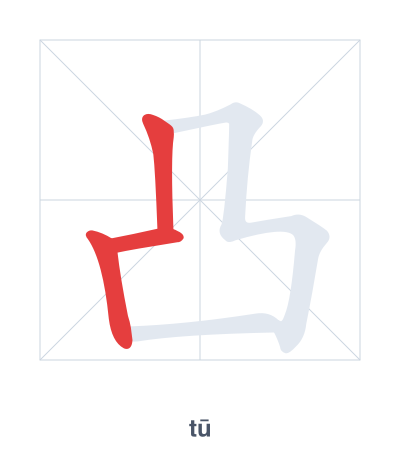
Open Hanzi Writer to see the animated stroke order and practice writing 凸 with real-time feedback.
The character 凸 (tū) is written with 5 strokes. Follow the standard Chinese stroke order: top to bottom, left to right, outside before inside. The radical 凵 is one of its key components.
Practice the correct stroke order with the Hanzi Writer app to see animated stroke-by-stroke guidance with real-time feedback.
凸 means Convex; protruding.
As an HSK Level 7 character, 凸 is an intermediate-level character.
凸 is a pictograph depicting something protruding outward, like a bump or bulge. Its ancient forms resembled a convex shape rising from a flat surface, and the modern character still visually suggests a raised center with indented sides.
💡 Memory Tip: Imagine a tiny hill (凸) popping up from a flat road, like a convex speed bump you have to drive over slowly.
墙上凸出一块。
qiáng shàng tū chū yī kuài
A piece protrudes from the wall.
放大镜是凸透镜。
fàng dà jìng shì tū tòu jìng
A magnifying glass is a convex lens.
地面有一处凸起。
dì miàn yǒu yī chù tū qǐ
There is a bump on the ground.
Open Hanzi Writer to see the animated stroke order and practice writing 凸 with real-time feedback.
✨ Animated stroke order · Handwriting recognition · HSK-graded practice · Free to use
The character 凸 consists of the radical 凵 (open box) at the bottom and a protruding shape on top. The overall form mimics a convex surface bulging outward, directly matching its meaning of "convex" or "protruding."