谇 (suì) means "to scold or reproach" in Chinese. It has 10 strokes with the radical 讠.
Rated 3.9/5 in difficulty (challenging).
Appears in 3+ common words including 谇语 (suì yǔ), 诟谇 (gòu suì), 闲谇 (xián suì).
Due to its 10 strokes, Hanzi Writer's error detection shows 谇 requires focused practice — most learners need 10+ attempts for consistent accuracy.
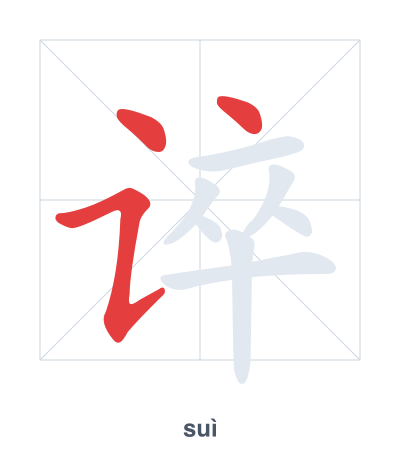
Open Hanzi Writer to see the animated stroke order and practice writing 谇 with real-time feedback.
The character 谇 (suì) is written with 10 strokes. Follow the standard Chinese stroke order: top to bottom, left to right, outside before inside. The radical 讠 is one of its key components.
Practice the correct stroke order with the Hanzi Writer app to see animated stroke-by-stroke guidance with real-time feedback.
谇 means to scold or reproach.
谇 is a phono-semantic compound: the radical 讠 (speech) indicates the act of speaking, while 卒 (zú, 'soldier' or 'abrupt') contributes the sound and hints at a sudden, harsh tone—like a sharp rebuke from a commander.
💡 Memory Tip: Picture a soldier (卒) standing stiffly at attention while receiving a blistering scolding (讠) from his furious officer.
不要在意别人的谇语。
bú yào zài yì bié rén de suì yǔ
Don't mind the scolding of others.
他无端遭到了诟谇。
tā wú duān zāo dào le gòu suì
He was insulted and scolded for no reason.
他从不参与那些闲谇。
tā cóng bù cān yù nà xiē xián suì
He never gets involved in that gossip.
Open Hanzi Writer to see the animated stroke order and practice writing 谇 with real-time feedback.
✨ Animated stroke order · Handwriting recognition · HSK-graded practice · Free to use
The character 谇 has the radical 讠 (speech) on the left and the phonetic component 卒 (zú) on the right. The speech radical indicates that the meaning involves speaking, and the right part hints at the pronunciation suì. Together, they form the idea of using words to scold or reproach.