诟 (gòu) means "to insult; to shame" in Chinese. It has 8 strokes with the radical 讠.
Rated 3.4/5 in difficulty (challenging).
Appears in 2+ common words including 诟病 (gòu bìng), 诟骂 (gòu mà).
Due to its 8 strokes, Hanzi Writer's error detection shows 诟 requires focused practice — most learners need 10+ attempts for consistent accuracy.
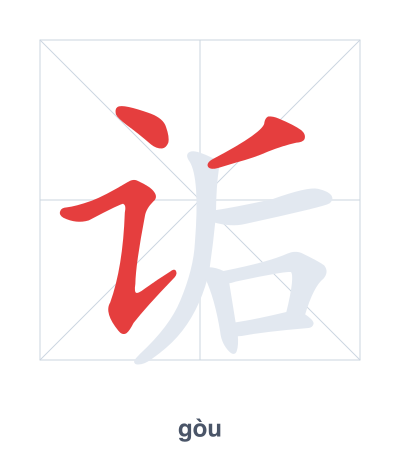
Open Hanzi Writer to see the animated stroke order and practice writing 诟 with real-time feedback.
The character 诟 (gòu) is written with 8 strokes. Follow the standard Chinese stroke order: top to bottom, left to right, outside before inside. The radical 讠 is one of its key components.
Practice the correct stroke order with the Hanzi Writer app to see animated stroke-by-stroke guidance with real-time feedback.
诟 means to insult; to shame.
This compound character combines the 'speech' radical (讠) with 'behind/after' (后), evoking the act of speaking behind someone's back—a classic form of insult and shame.
💡 Memory Tip: Picture a gossip (讠) whispering insults from behind (后) someone, shaming them unseen.
他的行为被人诟病。
tā de xíng wéi bèi rén gòu bìng
His behavior was criticized.
他遭到了诟骂。
tā zāo dào le gòu mà
He was verbally abused.
这个制度备受诟病。
zhè ge zhì dù bèi shòu gòu bìng
This system has been widely criticized.
Open Hanzi Writer to see the animated stroke order and practice writing 诟 with real-time feedback.
✨ Animated stroke order · Handwriting recognition · HSK-graded practice · Free to use
The left side 讠 is the speech radical, showing that the character relates to words or speaking. The right side 后 (meaning 'behind' or 'after') hints at speaking behind someone's back, which connects to the meanings of insulting or shaming someone.